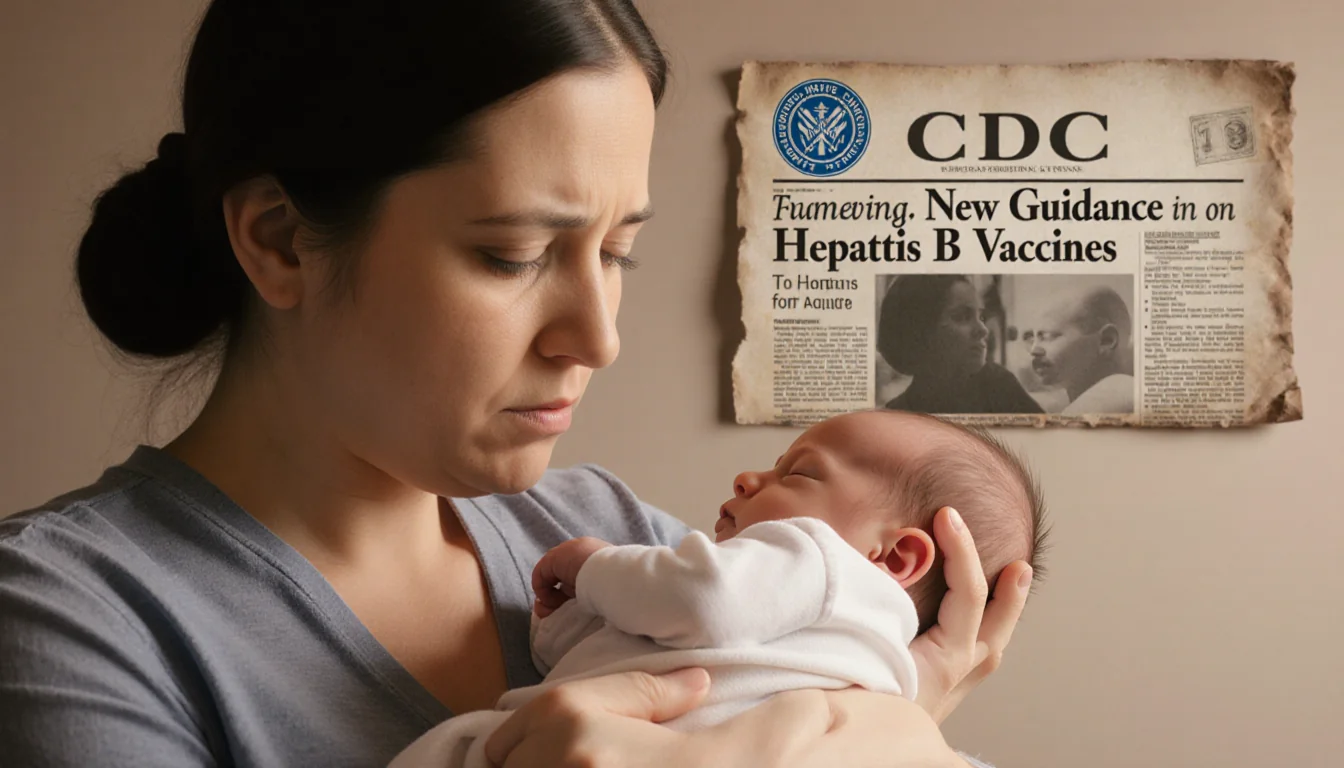
In a move that upended three decades of public health policy, the Centers for Disease Control and Prevention (CDC) has officially shifted its recommendation on the hepatitis B vaccine for newborns.
New Guidance for Mothers Who Test Negative
The agency now advises women who test negative for hepatitis B to discuss with health‑care providers whether their infants should receive the first dose of the vaccine within 24 hours of birth. The change follows a vote by the CDC’s vaccine advisory committee, whose members were appointed by Health Secretary Robert F. Kennedy Jr. after he fired the previous panel.
Committee Vote and Final Policy Adoption
The committee’s decision, made earlier this month, overturned CDC guidance that had been in place since 1991. Acting CDC Director Jim O’Neill accepted the change on Tuesday, marking the final step for the new policy to take effect. O’Neill said, “We are restoring the balance of informed consent to parents whose newborns face little risk of contracting hepatitis B.”
What the New Recommendation Means for Newborns
Under the updated guidance, infants who do not receive a birth‑dose vaccine should wait until at least two months of age for their first hepatitis B shot. The CDC still recommends that babies born to mothers who test positive for hepatitis B—or whose infection status is unknown—receive the vaccine within the first day of life. The agency is also reviewing a secondary recommendation that parents consult health‑care providers about testing children for hepatitis B antibodies before deciding whether to give second doses.
The hepatitis B vaccine is typically administered as a three‑dose series.
Reaction from Public‑Health Experts
Many public‑health experts criticized the committee’s decision. After the meeting, a chorus of doctors, political leaders and health officials called on O’Neill to ignore the suggested change and maintain the CDC’s recommendation. Their pleas were not heeded.
Senator Bill Cassidy, a liver‑disease doctor from Louisiana, said on X earlier this month: “Ending the recommendation for newborns makes it more likely the number of cases will begin to increase again. This makes America sicker.” He was among several medical professionals who publicly urged O’Neill not to adopt the advisory panel’s recommendations.
Pediatricians are expected to continue recommending that parents vaccinate their newborns for hepatitis B.
Impact on Insurance and Access
The Department of Health and Human Services has stated that the new recommendations will not affect insurance coverage of the shots. The vaccine will also remain available through the Vaccines for Children Program, which offers free shots for uninsured or underinsured children.
Context of Recent CDC Policy Changes
The hepatitis B decision is the latest in a series of CDC policy changes that have not been backed by science, according to some experts. Critics suggest that the agency’s guidance should no longer be trusted.
After Kennedy removed the long‑standing membership of the CDC’s vaccine panel—formally known as the Advisory Committee on Immunization Practices—in June, he replaced it with a group that has largely expressed skepticism of vaccines.
O’Neill, a former investment executive with no medical background, previously worked at the Department of Health and Human Services under President George W. Bush. He became acting CDC director in August after Kennedy abruptly fired the previous director, Susan Monarez. Kennedy said Monarez was fired for being untrustworthy; Monarez said she was dismissed for refusing to blindly approve the vaccine advisory panel’s recommendations.
Last month, the CDC altered a webpage that had once unequivocally stated that vaccines do not cause autism, claiming instead that studies have not ruled out a link. In October, O’Neill called on vaccine manufacturers to develop separate shots for measles, mumps and rubella without evidence to support breaking up the combined vaccine. In September, the CDC updated its guidance to tell pregnant women to consider avoiding acetaminophen—the active ingredient in Tylenol—because of a possible connection to autism in children.
State‑Level Responses and Professional Society Stance
Many states have begun to defer to recommendations from newly formed public‑health alliances or professional medical societies such as the American Academy of Pediatrics (AAP). The AAP continues to recommend a first dose of the hepatitis B vaccine within 24 hours of birth, followed by additional doses at 1 to 2 months and 6 to 18 months.
Key Takeaways
- The CDC now advises that newborns of hepatitis‑B‑negative mothers may wait until two months for their first vaccine dose.
- Babies of mothers who are hepatitis‑B‑positive or whose status is unknown must receive the vaccine within 24 hours of birth.
- The change follows a vote by a new vaccine advisory committee appointed by Health Secretary Robert F. Kennedy Jr. and was accepted by Acting CDC Director Jim O’Neill.
The reversal of a 30‑year guideline has sparked intense debate among health professionals and lawmakers, raising questions about the future of infant vaccination policies in the United States.