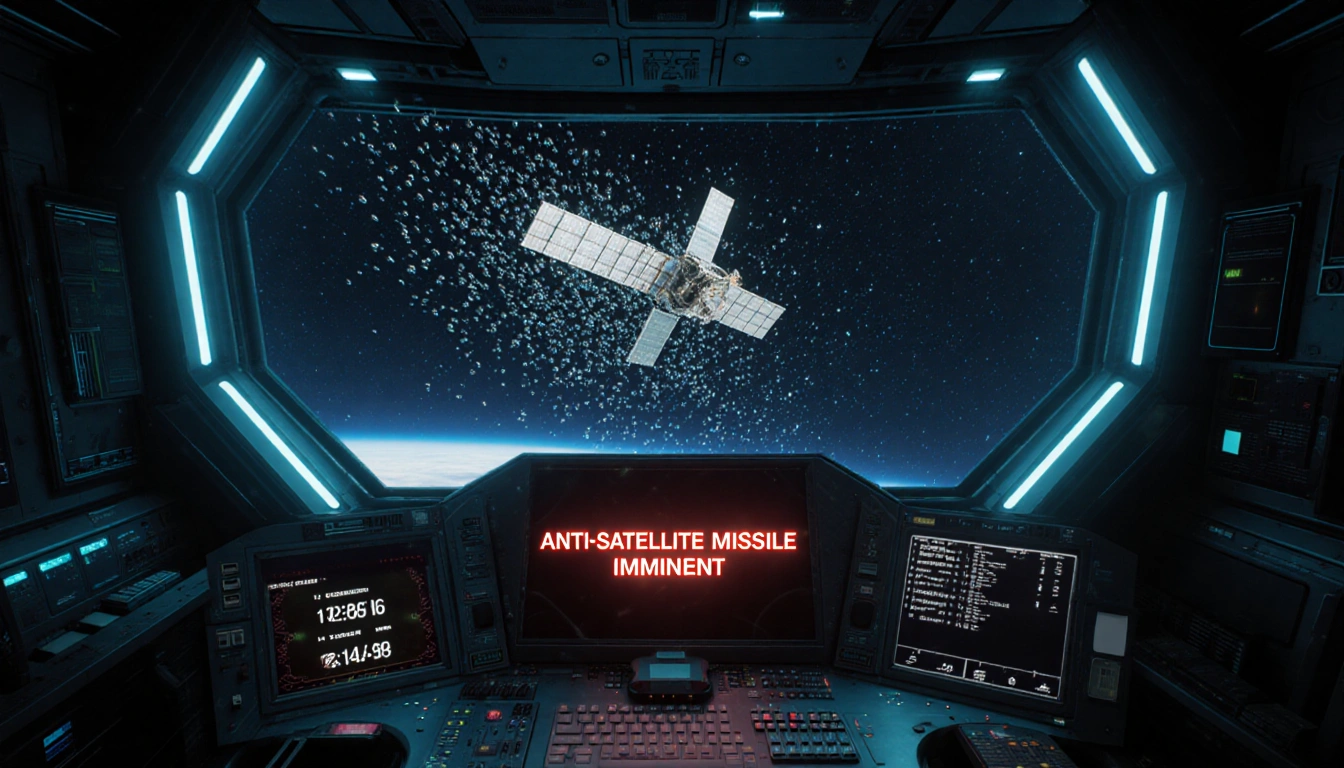
Intelligence services from two NATO nations have revealed that Russia may be working on a new anti-satellite weapon that could flood the skies with millions of tiny shrapnel pellets aimed at Elon Musk’s Starlink constellation, a move that could upend space security and jeopardize the satellite network that has become vital to Ukraine’s war effort.
The Proposed Weapon
The intelligence findings describe a so-called “zone-effect” system that would release hundreds of thousands of high-density pellets into the orbits occupied by Starlink satellites. The pellets would be only millimeters across, allowing them to evade detection by ground- and space-based scanners. If deployed, the weapon could potentially disable multiple satellites at once, but would also risk catastrophic collateral damage to other orbiting systems.
The analysis notes that the weapon would differ from the 2021 missile test that destroyed a defunct Cold War-era satellite. Instead, the new system would target many Starlinks simultaneously, possibly using yet-to-be launched formations of small satellites to release the pellets. Russia has fielded the S-500 ground-based missile system this month, which is capable of striking low-orbit targets.
Expert Opinions
Victoria Samson, a space-security specialist at the Secure World Foundation, said, “I don’t buy it. Like, I really don’t,” adding, “I would be very surprised, frankly, if they were to do something like that.” She cautioned that the sheer scale of debris could create space chaos, potentially forcing Moscow to rethink deployment.
Brigadier General Christopher Horner, commander of the Canadian military’s Space Division, acknowledged the possibility but noted uncertainty: “I can’t say I’ve been briefed on that type of system. But it’s not implausible,” he said. “If the reporting on the nuclear weapons system is accurate and that they’re willing to develop that and willing to go to that end, well it wouldn’t strike me as shocking that something just short of that, but equally damaging, is within their wheelhouse of development.”
Clayton Swope of the Center for Strategic and International Studies remarked, “If satellites start winking out with damage, I guess you could put two and two together.” He added, “Most damage would probably be done to the solar panels because they’re probably the most fragile part” of satellites, and that would likely bring them offline.
Swope also warned that the weapon could serve as a “weapon of fear,” noting, “It definitely feels like a weapon of fear, looking for some kind of deterrence or something.”
Russia’s Position

Kremlin spokesman Dmitry Peskov did not respond to AP messages seeking comment. Russia has previously called for United Nations efforts to stop the orbital deployment of weapons, and President Vladimir Putin has stated that Moscow has no intention of deploying nuclear space weapons.
The intelligence findings were shown to the AP under conditions that the services involved remain unnamed, and the AP could not independently verify the conclusions. The U.S. Space Force did not respond to e-mailed questions, and the French military’s Space Command declined to comment but said, “We can inform you that Russia has, in recent years, been multiplying irresponsible, dangerous, and even hostile actions in space.”
An official familiar with the findings, speaking anonymously, said the system is in active development but that details about deployment timing are too sensitive to share.
Impact on Ukraine and Global Space
Starlink’s high-speed internet service has become essential for Ukrainian forces, providing battlefield communications, weapons targeting, and civilian connectivity in areas hit by Russian strikes. The thousands of low-orbit satellites have been pivotal for Ukraine’s survival during its fourth-year full-scale invasion.
Russian officials have repeatedly warned that commercial satellites serving Ukraine’s military could be legitimate targets. An attack using tiny pellets could create a cloud of debris that would drift toward Earth, potentially damaging other orbiting systems such as China’s Tiangong space station and the International Space Station, which occupy lower orbits.
Swope noted that the space chaos could enable Moscow to threaten its adversaries without actually using the weapon, making it a deterrent in itself.
Potential Consequences
- Collateral Damage: Hundreds of thousands of pellets could disable not only Starlink satellites but also other commercial and governmental satellites sharing similar orbits.
- Space Debris: The debris cloud would eventually descend, risking damage to spacecraft and future launches.
- Strategic Deterrence: Even the threat of such a weapon could pressure adversaries, potentially altering the balance of power in space.
Samson warned that the drawbacks of an indiscriminate pellet weapon could steer Russia away from deployment. She said, “They’ve invested a huge amount of time and money and human power into being, you know, a space power.” She added, “Using such a weapon ‘would effectively cut off space for them as well,'” and concluded, “I don’t know that they would be willing to give up that much.”
Key Takeaways
- Russia may be developing a zone-effect anti-satellite weapon aimed at Starlink, capable of releasing millions of tiny pellets.
- The weapon could disable multiple satellites at once but would risk widespread collateral damage and space debris.
- Expert analysts express doubt about the weapon’s feasibility and potential strategic cost.
The intelligence findings underscore the fragility of the modern space environment and the geopolitical tensions that could arise from new anti-satellite technologies. As the world watches, the balance between deterrence and the preservation of space infrastructure remains a pressing concern.