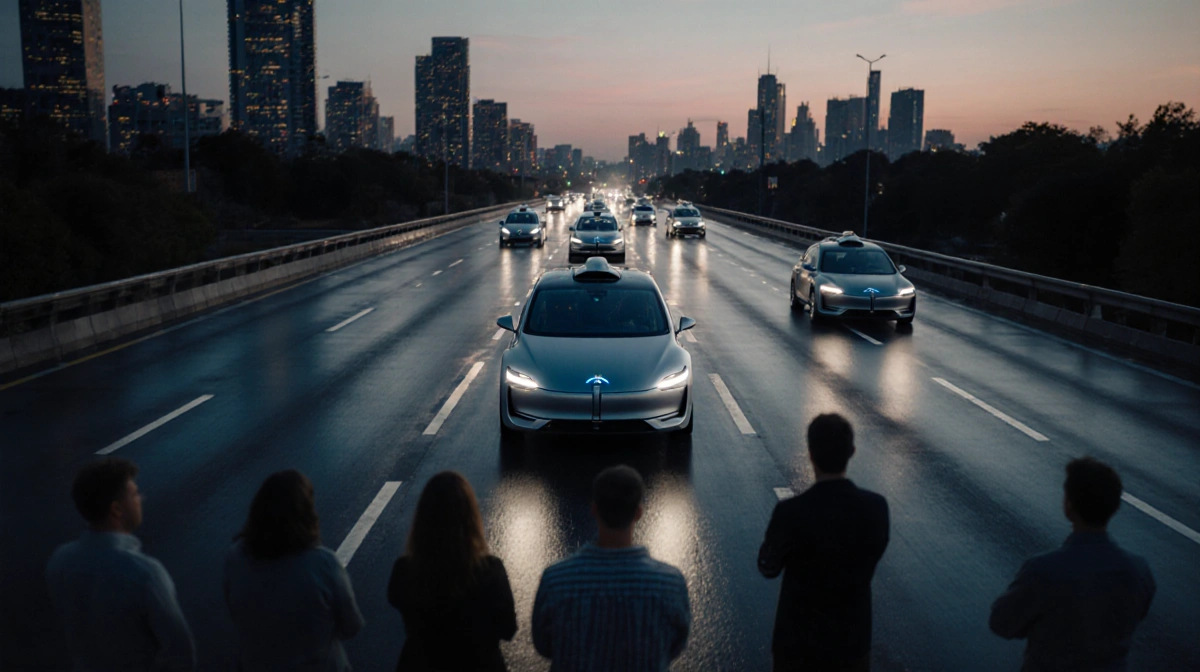
Self-driving cars dominated CES 2026, signaling the industry is accelerating from cautious pilot programs to full-scale commercial launches in 2026.
At a Glance
- Waymo will add 10+ cities to its robotaxi network in 2026
- Uber, Lucid and Nuro will debut the Lucid Gravity robotaxi by year-end
- Zoox plans public rollout in San Francisco after Las Vegas launch
- Why it matters: Riders in major metro areas will soon hail truly driverless cars, changing daily transportation
Companies showcased autonomous fleets, personal AVs, shuttles and industrial trucks, underscoring that the long-promised driverless future is arriving now.
Robotaxis Lead the Charge
Waymo, already operating in select areas, confirmed expansion to more than a dozen new cities this year. Zoox, owned by Amazon, opened its Las Vegas service last year and will likely welcome all public riders in San Francisco within months.
Uber partnered with EV maker Lucid Motors and AV developer Nuro to unveil the Lucid Gravity robotaxi. The SUV will begin passenger service in the San Francisco Bay Area late 2026 before rolling out to additional locations.
Tensor revealed a consumer-owned robocar shipping later this year. Owners can list the vehicle on Lyft when not in use, letting it earn money as a robotaxi.
Tech That Powers the Ride
Nvidia CEO Jensen Huang introduced Alpamayo, an open-source suite of AI models that help autonomous vehicles handle complex scenarios “using human-like reasoning,” according to the company.
Waymo’s newest vehicle, the Ojai, is a modified Zeeker fitted with the firm’s sixth-generation self-driving stack. The sensor suite and software improvements aim to reduce cost per mile while improving safety margins.
Public Transit Goes Driverless
May Mobility and Tecnobus displayed a 30-seat electric minibus designed for autonomous fixed routes. The partners expect the vehicle to enter service in the coming years.
Holon, a Benteler Mobility subsidiary, announced a deal with Lyft to deploy self-driving shuttles, starting at airports and select cities later this year.
Industrial Autonomy Expands
Beyond passenger transport, CES exhibitors demonstrated self-driving tech for heavy industry:
- Caterpillar exhibited autonomous construction equipment
- Kodiak and Bosch detailed plans to scale driverless truck manufacturing
Safety at Scale
AV safety expert Phil Koopman emphasized that deploying vehicles is only the beginning. The larger challenge is preventing failures as fleets grow into thousands of units.
Cruise scaled rapidly in San Francisco starting in 2022, but California suspended its permit in 2023 after a robotaxi struck a pedestrian who had been hit initially by a human-driven car. General Motors shut down the Cruise program before a relaunch could occur.
Waymo has avoided Cruise-level penalties, though its cars have driven into construction zones, blocked roads during a San Francisco power outage and required remote assistance in unusual situations.
“Once you have thousands of vehicles on the road, things that used to be rare have a way of happening on a regular basis,” Koopman said.
Paul Miller, principal mobility analyst at Forrester, noted that regulators and the public treat autonomy-related crashes far more harshly than human-caused collisions. A serious robotaxi accident can sink a company, whereas a conventional taxi crash rarely threatens the taxi firm’s survival.
Business Models Take Shape
Fleet ownership appears most viable in the near term, Miller said. Tesla and Tensor tout a sharing model where private cars operate as robotaxis when owners don’t need them, yet questions linger:
- Insurance and liability when strangers ride unsupervised
- Wear-and-tear on personal vehicles
- Revenue split between owner and platform
Tensor will integrate with Lyft for scheduling, billing and fleet oversight, hoping to offset these concerns.
Competitive Shakeout Ahead
CES 2026 revealed dozens of contenders across cars, shuttles, buses and industrial vehicles. Miller predicts most will fail or be acquired, with only a handful surviving the combination of safe operation, solid technology and a sustainable business model.
High costs, new deployment environments and multi-layered regulation create steep hurdles. As momentum builds, pressure mounts on each company to prove it can cross the commercial finish line.
Key Takeaways
- Major expansion: Waymo, Zoox, Uber-Lucid-Nuro and Tensor all plan 2026 service launches
- Diverse uses: Robotaxis, consumer AVs, public shuttles and autonomous trucks move from pilot to product
- Safety imperative: Past scaling missteps show that rigorous operations and public trust are critical
- Economic reality: Fleet-first models dominate; personal car-sharing robotaxis remain experimental
- Competition intensifies: Dozens of players chase a market that will likely consolidate to a few winners