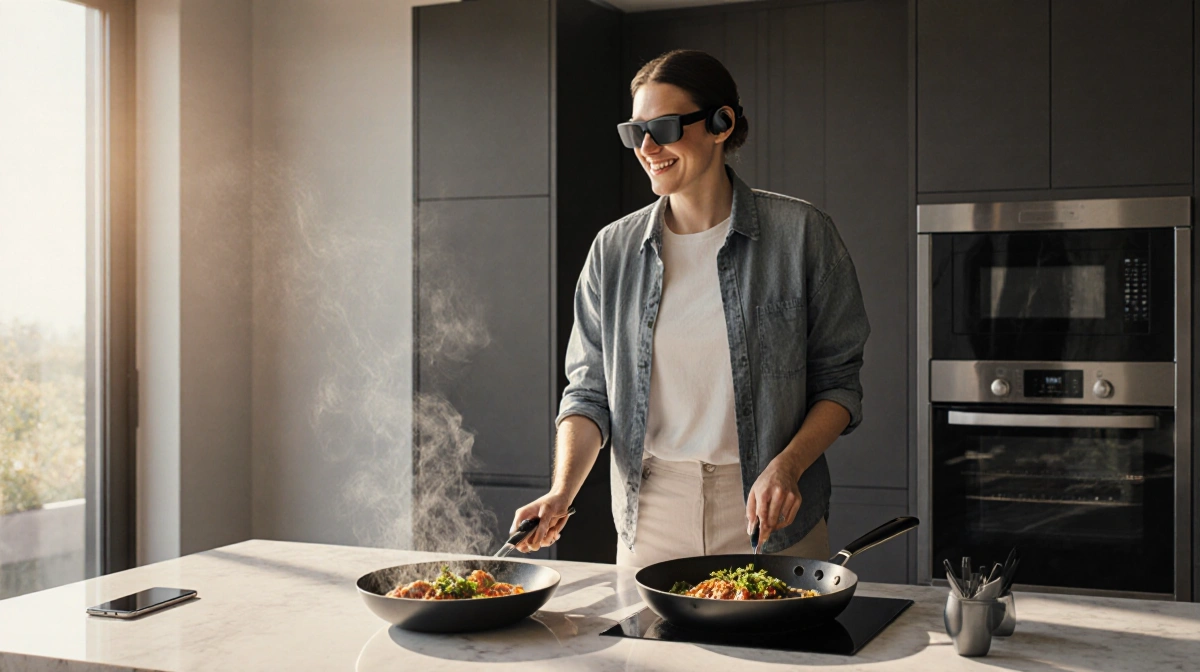
A tech reviewer tested $250 Solos AirGo A5 audio glasses in the kitchen to see if AI assistance could simplify cooking. The experiment revealed mixed results, with recipe guidance working for familiar dishes but failing when learning new meals.
At a Glance
- Smart glasses handled basic cooking advice and measurements accurately
- Recipe walkthroughs worked well for known dishes like Alfredo sauce
- AI hallucinated ingredients when asked to find new recipes
- Why it matters: Voice-only AI assistants may not be reliable for complex cooking tasks
The reviewer approached the challenge from three angles: getting basic cooking tips, following a known recipe, and learning a new dish. The Solos glasses use temple-mounted speakers and connect to AI chatbots through the companion app.
Basic Cooking Tasks Show Promise
The smart glasses performed well with fundamental kitchen questions. They accurately answered queries about boiling eggs, suggested seasoning choices, and handled measurement conversions. When asked how many teaspoons are in 1/3 cup, the AI provided the correct answer.
The glasses also successfully converted a cup of cheese to grams, accounting for both volume and density. However, when asked about the science behind why acidic foods taste good, the chatbot fabricated article titles and links.
Ingredient identification proved inconsistent. The glasses correctly identified a delicata squash but misidentified a spaghetti squash as a Korean melon.
Known Recipes Work Best
The most successful part of the experiment involved using the glasses to walk through a familiar Alfredo sauce recipe from Betty Crocker’s Cookbook. The AI accurately captured ingredients and instructions, allowing the reviewer to manage three recipes simultaneously.
Voice commands like “I’m ready for the next step on the chicken” enabled smooth transitions between dishes. The glasses even provided plating advice that improved the final presentation.
Two issues emerged: the glasses lack timer functionality, and text-to-speech ignores fraction symbols. This caused “3/4 cup of cheese” to be read as “34 cups of cheese.”
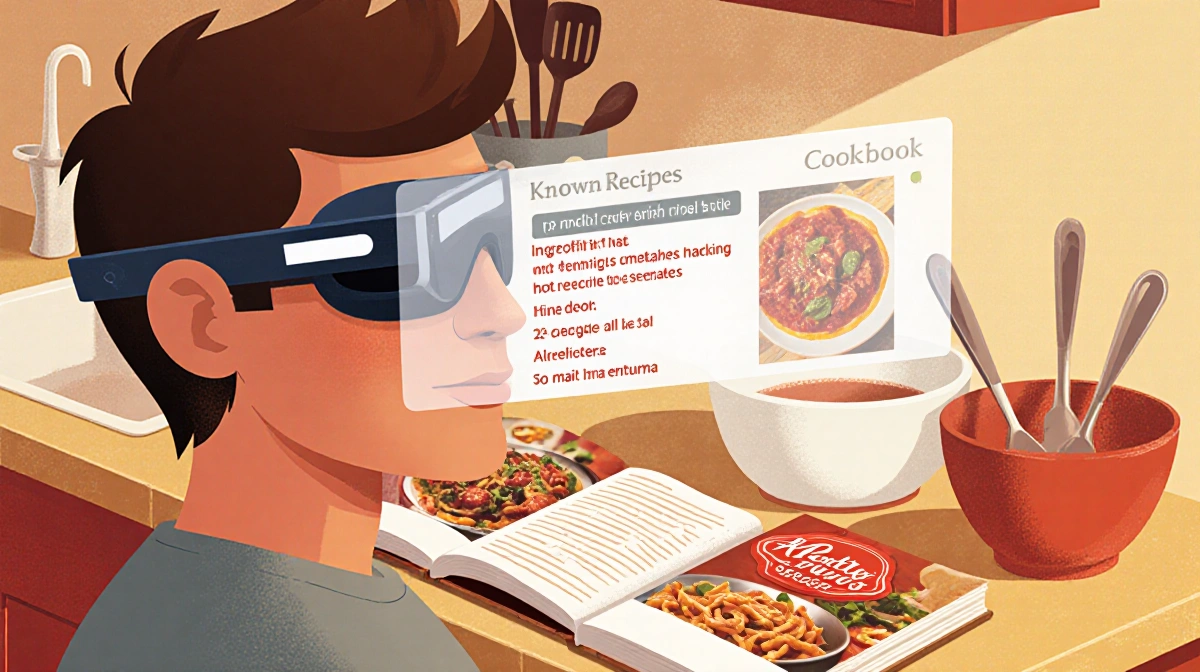
New Recipe Learning Fails
The experiment collapsed when asking the glasses to find a new recipe for jollof rice. The AI claimed to source ingredients from Dash of Jazz but added garlic and ginger while omitting tomato sauce and white pepper.
Subsequent requests for quantities continued to hallucinate ingredients. The glasses suggested cayenne pepper and smoked paprika, neither of which appeared in the original recipe. The final ingredient list bore no resemblance to actual jollof rice.
Voice Controls Beat Physical Buttons
The reviewer experienced motion sickness when using the physical controls, finding voice commands more comfortable. While the directional speakers work adequately, they’re not headphones – others can hear the audio at higher volumes.
The glasses offer multiple AI models including GPT 4o Mini, Claude 3 Haiku, and Gemini 2.0 Flash. The reviewer chose Gemini for familiarity, making the experiment more about cooking with AI than smart glasses specifically.
Key Takeaways
Smart glasses show potential for guiding cooks through familiar recipes but cannot reliably find or verify new recipes. The $250 price point makes sense for basic AI access, but the reviewer’s setup of separate glasses, earbuds, and the Gemini app provides equivalent functionality.
The technology works best as a hands-free way to access AI assistance for simple kitchen tasks, not as a comprehensive cooking companion. Until smart glasses gain better displays and more reliable AI, traditional methods remain superior for learning new recipes.