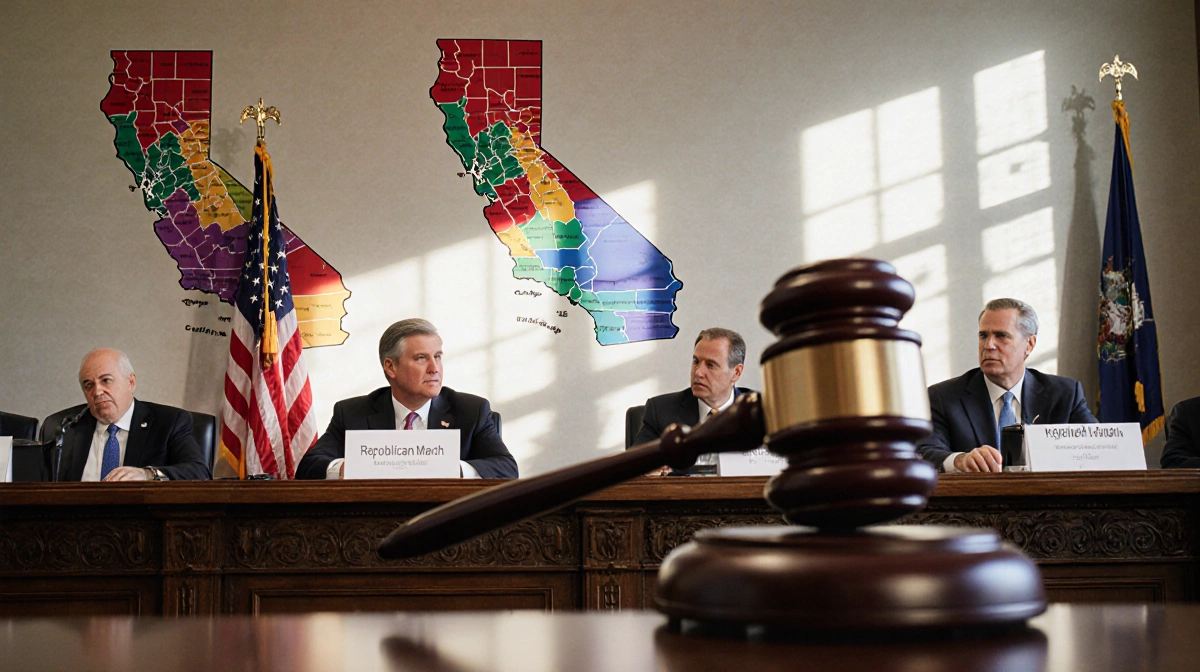
At a Glance
- A federal court upheld Proposition 50, keeping California’s new congressional maps in place for the 2026 midterms.
- Judges ruled 2-1 that the map does not violate the Voting Rights Act.
- California Republicans had claimed the lines illegally favored Hispanic voters.
- Why it matters: The decision clears the way for Democrats to potentially gain five House seats next cycle.
A federal court on Wednesday rejected a Republican lawsuit seeking to block Proposition 50, the voter-approved measure that redraws California’s congressional boundaries ahead of the 2026 midterm elections.
The three-judge panel of the U.S. District Court for the Central District of California ruled 2-1 that the new map, approved by nearly 65 percent of voters last November, does not violate the Voting Rights Act. The court found that the plaintiffs failed to prove the lines were drawn with discriminatory intent or effect.
The Lawsuit
The California Republican Party filed suit shortly after Prop 50 passed, arguing the map unlawfully packed Hispanic voters into select districts to benefit Democrats. GOP attorneys claimed the configuration diluted Latino voting strength elsewhere, running afoul of federal protections.
In their complaint, Republicans pointed to language in the ballot measure stating it was a direct response to Republican redistricting moves in Texas and other states. They contended the justification revealed an improper partisan motive.
The court disagreed, concluding the evidence did not show the map diminished the ability of Hispanic voters to elect representatives of their choice.
What Prop 50 Does
Prop 50-formally titled the Election Rigging Response Act-temporarily overrides California’s independent redistricting commission. It authorizes lawmakers to replace the existing congressional map with new district lines for the 2026 midterms.
Key provisions:
- Gives the Democratic-controlled legislature authority to redraw boundaries
- Targets an estimated five additional U.S. House seats for Democrats
- Sunsets after the 2026 election, returning control to the commission
Supporters framed the measure as a defensive maneuver against Republican gerrymandering in Texas, Florida and other large states.
Political Reaction
Governor Gavin Newsom hailed the ruling, saying Republicans had tried to “nullify” the will of voters.
“Republicans’ weak attempt to silence voters failed,” Newsom said in a statement released minutes after the decision. “California voters overwhelmingly supported Prop 50-to respond to Trump’s rigging in Texas-and that is exactly what this court concluded.”
State Attorney General Rob Bonta, whose office defended the law, said every legal challenge to date has been turned aside.
“Today’s decision upholds the will of the people,” Bonta said. “It also means that, to date, every single challenge against Proposition 50 has failed.”
A spokesperson for the California Republican Party declined immediate comment. GOP leaders previously said they were prepared to appeal if the panel ruled against them.
Path to Supreme Court
The dissenting judge, George H. Wu, indicated in a brief opinion that he would have struck down the map, writing that the majority applied an overly deferential standard. His position could bolster Republican hopes for an eventual hearing before the U.S. Supreme Court.
The high court last year upheld Texas’ redrawn maps in a separate case, setting a precedent that makes it harder to prove illegal gerrymandering. Legal analysts say Republicans could use that ruling to press their claims in an appeal.
A petition to the nation’s highest court would need to be filed within 90 days.
What Happens Next
With the lower-court victory in hand, California election officials will proceed to implement the new boundaries. Campaigns and potential candidates must now use the Prop 50 map when gathering signatures and filing paperwork for the 2026 contests.
Key deadlines:
- Candidate filing window opens January 4, 2026
- Primary election set for June 2, 2026
- General election scheduled for November 3, 2026
Democrats currently hold 42 of California’s 52 House seats. Party strategists believe the redrawn lines could flip as many as five additional districts, padding their narrow majority in Congress.
Key Takeaways
- A federal court sided with California Democrats, keeping the Prop 50 map intact
- Republicans can appeal, but face uphill odds under recent Supreme Court precedent
- The ruling sets the battlefield for 2026 House races in the nation’s most populous state