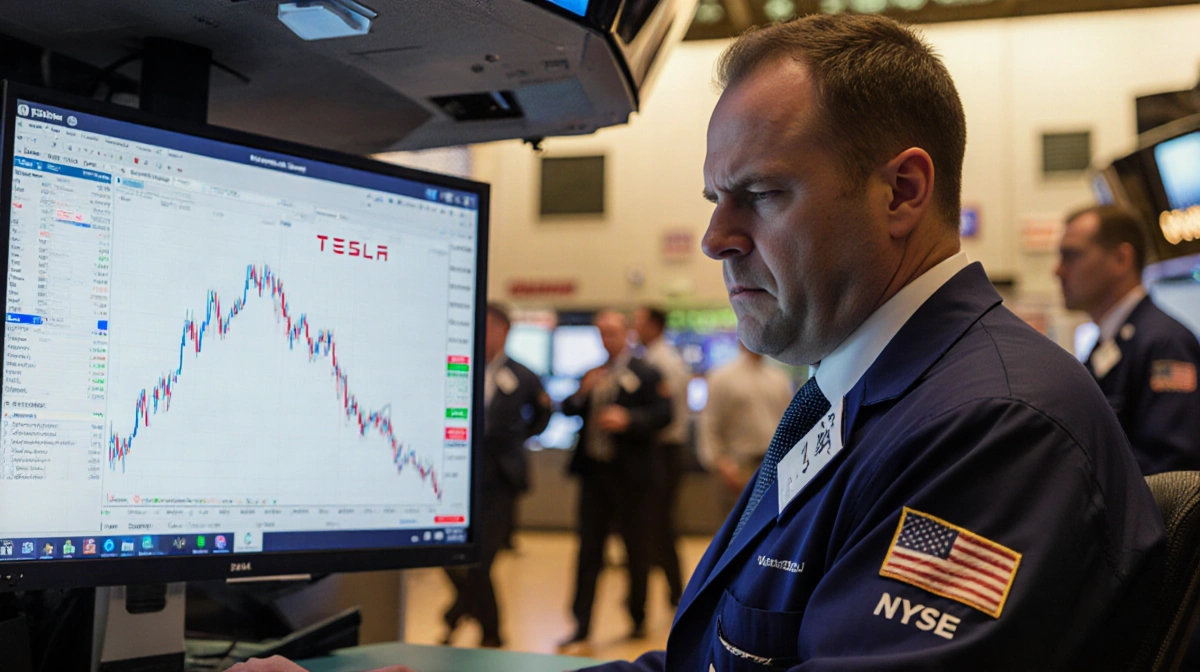
Tesla shares dropped more than 4% in early trading Wednesday after a top analyst cut his rating on the electric-vehicle maker, citing weakening demand and mounting competition.
At a Glance
- Tesla stock fell 4.2% after a Wall Street downgrade
- Analyst cites “softer” EV demand and rising competition
- Price target trimmed to $210 from $215
- Shares remain down roughly 25% over the past 12 months
Why it matters: The downgrade highlights investor anxiety over whether Tesla can defend its dominant market share as legacy automakers and new entrants flood the EV space.
The move, published ahead of the opening bell, came from Goldman Sachs analyst Mark Delaney, who lowered his investment opinion on Tesla from “Buy” to “Neutral.” While Delaney kept a constructive long-term view on the company’s technology and manufacturing scale, he warned that near-term headwinds are intensifying.
“We see softer EV industry sentiment and higher competition,” Delaney wrote in a note to clients. He expects those forces to pressure Tesla’s deliveries and pricing through at least the first half of next year.
Weaker Demand Signals
Delaney’s caution follows a string of data points showing global EV demand growth is slowing. Monthly registration tallies from China and Europe have trailed forecasts, while U.S. dealers report swelling inventory of unsold battery-powered cars and trucks.
Tesla, the world’s most valuable EV manufacturer, has responded by repeatedly trimming prices in its two largest markets. The cuts have helped the company maintain unit sales but have also compressed automotive gross margins, which peaked above 30% in 2022 and slipped to roughly 16% last quarter.
The analyst expects that trend to continue. Delaney now models Tesla delivering 1.8 million vehicles in 2024, flat versus this year and below the Street consensus of 2.1 million. He also trimmed his average selling price forecast, projecting a mid-single-digit decline in 2024 as Tesla offers incentives to move metal.
“We believe Tesla will need to further reduce pricing to stimulate demand,” Delaney said. He flagged China’s aggressive EV makers-BYD, NIO and Xpeng among them-as a particular threat, noting their ability to launch feature-rich models at lower price points.
Competitive Heat Rises
Traditional automakers are compounding the pressure. Ford, General Motors and Volkswagen have accelerated their own EV programs, unveiling electric SUVs and pickups that target Tesla’s highest-volume segments. Ford’s Mustang Mach-E already outsells Tesla’s Model 3 in parts of the U.S. Midwest, while GM’s upcoming Equinox EV is expected to carry a sticker price below $30,000 after federal tax credits.
Delaney believes Tesla’s technological edge is narrowing. “Battery cost advantages have shrunk and competitors now offer comparable driving range and charging speeds,” he wrote. He pointed to recent teardown analyses showing Tesla’s hardware content advantage versus rivals has fallen to the single-digit percent range, down from more than 20% two years ago.
The analyst also highlighted Tesla’s limited product cadence. The company has not launched an entirely new consumer model since the Model Y in 2020, and its long-promised Cybertruck remains in pilot production. Meanwhile, competitors have rolled out dozens of new EV nameplates, giving shoppers more choice than ever.
Margin Squeeze
Goldman’s downgrade underscores a broader investor debate: Can Tesla protect profitability while fending off rivals? The company’s operating margin topped 19% in 2022, among the best in the auto industry, but Delaney sees that figure falling to 12% next year as average selling prices decline faster than manufacturing costs.
Tesla has responded by idling some production lines and slashing capital-expenditure budgets. Management recently pushed back expansion plans for its Mexico Gigafactory, citing uncertain demand. Cost cuts have helped preserve cash-Tesla ended last quarter with $29 billion in cash and equivalents-but they also risk slowing the company’s ability to launch new models and scale battery output.
Delaney trimmed his 2024 earnings per share estimate to $2.90 from $3.20, well below the Wall Street consensus of $3.75. He cites both lower revenue and a reduced gross-margin assumption of 16.5%, down from 18% previously.
Valuation Still Lofty
Even after a steep pullback, Tesla trades at roughly 60× Delaney’s new 2024 EPS forecast, a premium to large-cap tech names and more than triple the multiple of traditional automakers. The analyst argues that valuation leaves little room for disappointment.
“Tesla remains a premium growth story, but we see limited catalysts over the next 12 months,” he wrote. He noted that key upside drivers-approval of full self-driving software in major markets, energy-storage outperformance and a cheaper next-gen vehicle-appear at least a year away.
Investors have grown accustomed to volatility. Tesla stock has swung more than 5% on an intraday basis 42 times so far in 2023, according to News Of Los Angeles data, making it one of the most actively traded names in the S&P 500. Options markets imply a 9% post-earnings move when Tesla reports next month, nearly double the average for consumer discretionary stocks.
Street Split
Goldman’s cut adds to a growing divide on Wall Street. About 45% of analysts tracked by FactSet now rate Tesla “Hold,” up from 30% a year ago, while “Buy” ratings have slipped to 35%. Price targets span a wide range-from a high of $400 at one boutique firm to a low of $85 at a large European bank.
Bulls argue Tesla’s energy-storage and services businesses will help offset any automotive weakness. The company deployed 9.4 GWh of battery storage in the third quarter, up 90% year-over-year, and management has guided for continued triple-digit growth. Services revenue also hit a record $2.7 billion last quarter, led by Supercharging and part sales.
Delaney acknowledged those opportunities but said they are “largely priced in” at current levels. He kept Tesla on Goldman’s “America’s Conviction List” for years before Wednesday’s removal, and his downgrade may influence other institutional investors who follow the bank’s research.
Key Takeaways
- Goldman Sachs downgraded Tesla to “Neutral,” citing softer EV demand and rising competition
- Analyst trimmed his price target to $210, implying modest upside from Tuesday’s close
- Tesla has slashed prices to defend market share, pressuring margins
- Delaney sees vehicle deliveries staying flat in 2024, below consensus
- Shares remain expensive at roughly 60× next year’s earnings
Tesla has not yet responded to a request for comment on the downgrade.