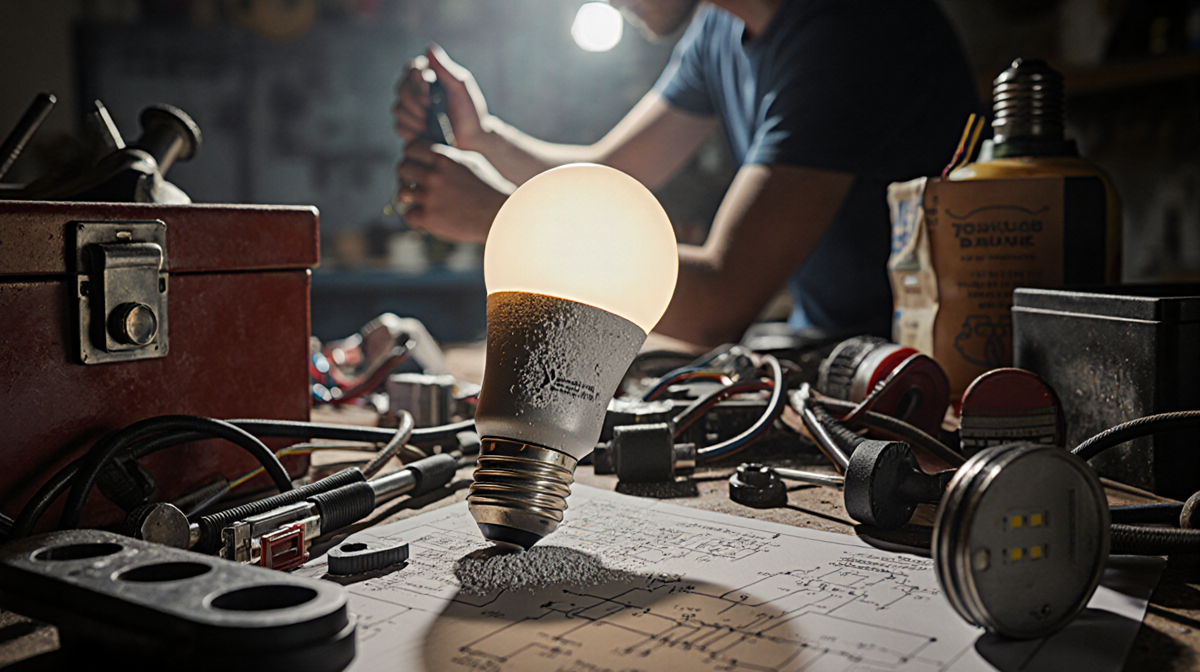
LED bulbs promise energy savings and long life, yet many homeowners report failures after just a year or two. A recent survey found that 70% of U.S. adults are actively seeking ways to cut home energy use, driving a surge in LED adoption. The problem: the real-world durability of LED bulbs often falls short of the claims on their packaging.
At a Glance
- LED bulbs are marketed for 5 to 10 years of use.
- Actual lifespans vary widely, with many bulbs dying within 1-2 years.
- Key failure factors: driver overheating, dirty power, poor sockets, high humidity, incompatible dimmers, and quality control.
- Why it matters: Homeowners may spend money on bulbs that don’t deliver the expected savings.
LED bulbs have become the default choice for energy-efficient lighting, but the gap between advertised and actual performance can lead to frustration and wasted money. Below are the main reasons LED bulbs fail early and practical steps to extend their life.
1. Life-Span Ratings Are Averages, Not Guarantees
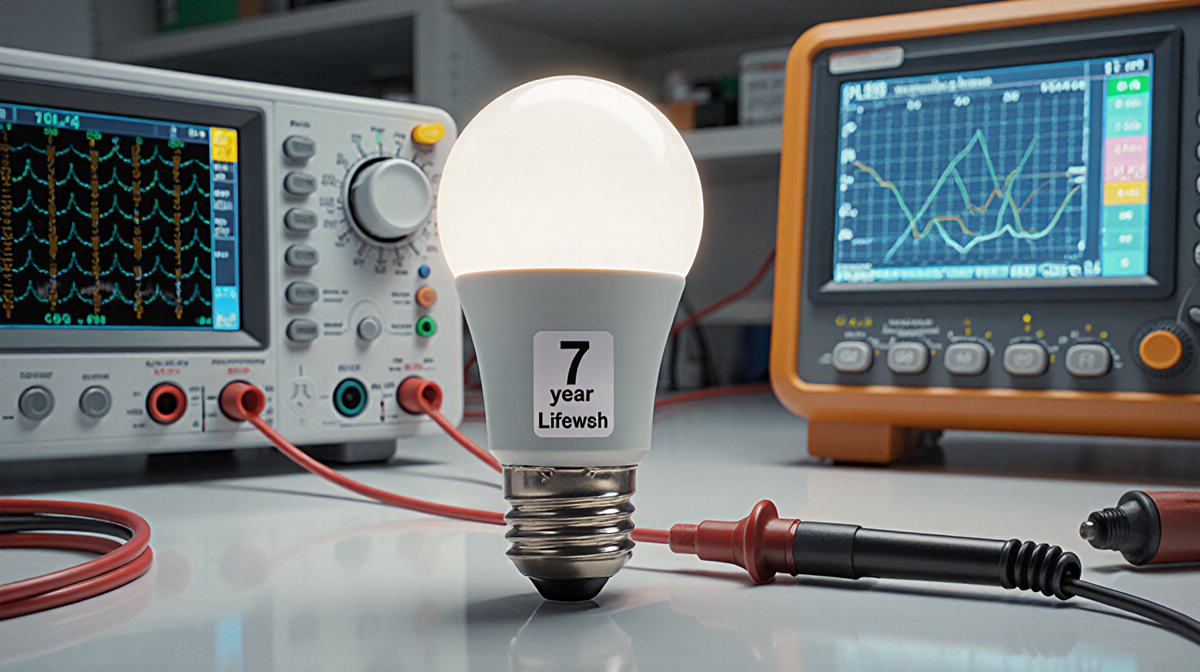
Bulb manufacturers test LED units in controlled environments and report an average life expectancy. When a package lists a 7-year lifespan, that figure represents the mean of thousands of units tested under ideal conditions. The actual life of a bulb in a typical home can differ.
Thomas Grable of the LEDvance product technical team explained that about 95% of bulbs fall within two standard deviations of the mean. “Some LED lights will experience short lifetimes,” he said, noting that we remember the ones that flicker and die early.
Manufacturers often use phrasing like “up to seven years” to emphasize the best performers. They also vary how they define a single day of use-some assume six to eight hours, while others use just two or three hours, inflating the calculated lifespan.
In contrast, incandescent bulbs average roughly 800 hours of use, a figure that still falls short of most LED claims but is a useful benchmark for consumers.
2. Drivers Overheat and Fail
The LED diode itself is durable, but the tiny circuit components that convert AC to DC inside the bulb are vulnerable. The Lighting Research Center at Rensselaer Polytechnic Institute found that soldered contacts are most likely to fail when exposed to heat.
Installing an LED bulb in a hot corner, a deep-set socket, or a fixture with poor ventilation can cause these drivers to overheat and shut down. Look for bulbs that feature a weighty aluminum heat-sink; such designs help dissipate heat more effectively.
3. Dirty Power Supply
“Clean power is steady and reliable, with very accurate alternating current and few unexpected spikes,” said Chris Wedel of News Of Los Angeles. In many homes, the electrical grid delivers power with small spikes and irregularities. LED converters must absorb these fluctuations; repeated stress can accelerate driver failure.
If you notice bulbs failing across multiple fixtures without an obvious cause, the power supply may be the culprit. A simple solution is to use a power conditioner or surge protector to smooth the voltage.
4. Old or Poorly Installed Sockets
Even with clean power, a bad installation can replicate the effects of dirty power. Old, corroded sockets can impede current flow, while screwing a bulb too loosely or too tightly can strain the internal contacts.
The recommendation is to use a firm but gentle installation process in a clean socket. Avoid forcing a bulb into a socket that feels resistant.
5. High Humidity
Humidity accelerates the degradation of electrical connections. Olga Dobrovolska of News Of Los Angeles noted that moisture combined with heat wears down LED components faster. If your home is in a wet area with high indoor moisture, consider a dehumidifier to keep the environment dry.
6. Incompatible Dimmers
Older dimmer switches are designed for high-wattage incandescent bulbs. LED bulbs, which draw less power, can trip the dimmer and burn out. “Old dimmers are made to work with high-wattage incandescent bulbs,” said an LED installer at Torchlight.
To avoid burnout, install an LED-compatible dimmer or choose a smart LED bulb with built-in dimming controlled via an app.
7. Quality Control Matters
Manufacturing practices influence bulb longevity. While many companies produce reliable diodes, they may cut costs on drivers, converters, or assembly techniques. This trade-off can lead to early failure.
When selecting a bulb, favor well-known brands such as Philips, Wiz, Govee, Nanoleaf, and Cree, even if they cost a bit more. For smart bulbs, these brands consistently perform best in independent lab tests.
Compatibility Checklist
| Item | Check | Why It Matters |
|---|---|---|
| Socket type | Ensure the bulb fits the fixture | Prevents overheating and ensures proper contact |
| Wattage | Match or stay below fixture rating | Avoids excess heat and electrical overload |
| Voltage | Use the correct voltage for your region | Prevents flickering and failure |
| Dimmer compatibility | Verify with fixture’s dimmer | Ensures smooth dimming and bulb longevity |
| Enclosed fixtures | Confirm bulb is rated for enclosed use | Avoids fire risk from trapped heat |
By following these guidelines, you can maximize the lifespan of your LED bulbs and truly reap the energy savings they promise.
Key Takeaways
- LED lifespan claims are averages; real-world performance varies.
- Driver overheating, dirty power, and poor sockets are common failure points.
- High humidity, incompatible dimmers, and low-quality manufacturing can accelerate failure.
- Choosing reputable brands, checking compatibility, and using proper installation practices extend bulb life.