> At a Glance
> – 2026 signals a pivot from scaling to practical AI deployment.
> – Small language models and world models are becoming industry staples.
> – Agent protocols like MCP are unlocking real-world agent integration.
> – Why it matters: AI is shifting from hype to tools that augment work and embed in devices.
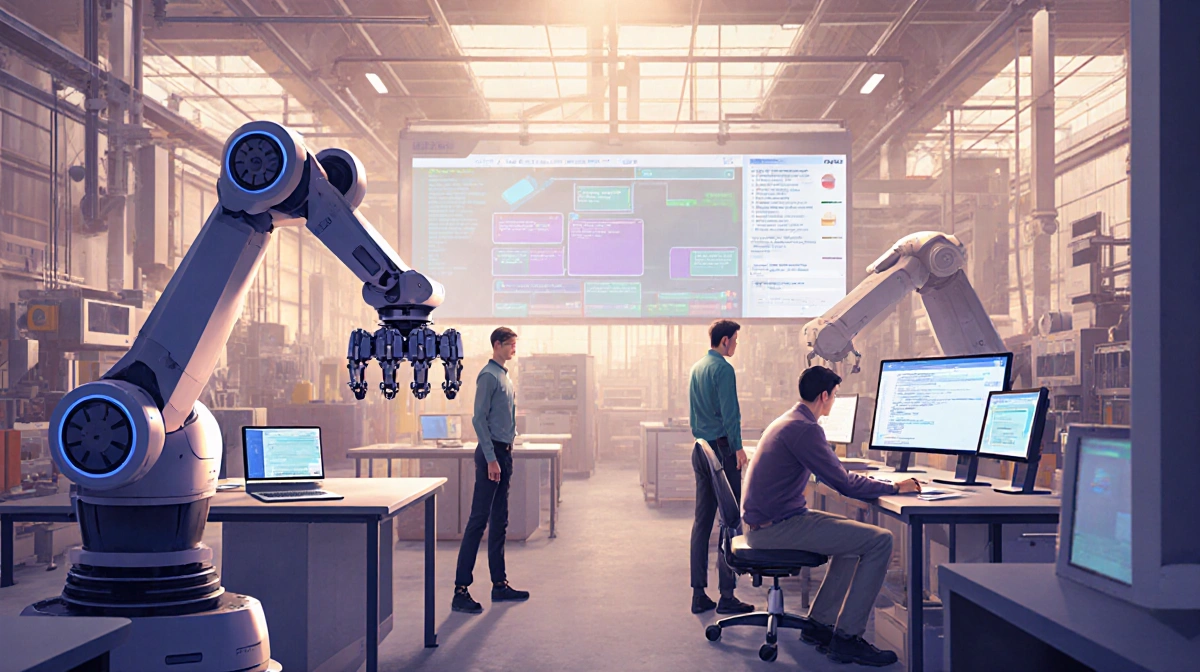
The AI landscape is shifting in 2026. After years of building ever-larger language models, the focus is now on smaller, more practical deployments that fit into real workflows and devices. This change is driven by limits to scaling, new architectures, and a surge in world and agent models.
Beyond Scaling
The era of scaling-where larger transformers unlocked new capabilities-has hit a plateau. Researchers such as Yann LeCun and Ilya Sutskever have highlighted flattening pre-training results, indicating that simply adding more compute will no longer drive breakthroughs. Kian Katanforoosh predicts that the next five years will hinge on discovering a better architecture that significantly improves upon transformers; otherwise, model gains will stall.
Kian Katanforoosh said:
> “I think most likely in the next five years, we are going to find a better architecture that is a significant improvement on transformers.”
Kian Katanforoosh added:
> “And if we don’t, we can’t expect much improvement on the models.”
Smaller, Faster Models
Fine-tuned small language models (SLMs) are emerging as the new workhorse for enterprises. Andy Markus says SLMs will become the standard in 2026, offering cost and speed advantages while matching large models in accuracy for domain tasks. Mistral and ABBYY’s Jon Knisley argue that after fine-tuning, small models outperform larger ones on many benchmarks and are ideal for local deployment on edge devices.
Andy Markus said:
> “Fine-tuned SLMs will be the big trend and become a staple used by mature AI enterprises in 2026, as the cost and performance advantages will drive usage over out-of-the-box LLMs.”
Andy Markus added:
> “We’ve already seen businesses increasingly rely on SLMs because, if fine-tuned properly, they match the larger, generalized models in accuracy for enterprise business applications, and are superb in terms of cost and speed.”
Jon Knisley said:
> “The efficiency, cost-effectiveness, and adaptability of SLMs make them ideal for tailored applications where precision is paramount.”
World Models and Gaming
World models-systems that learn how objects move in 3D space-are gaining traction. LeCun’s new lab seeks a $5 B valuation, while Google’s DeepMind launched a real-time interactive model in August. Startups like Decart, Odyssey, and World Labs’ Marble, along with General Intuition’s $134 M seed round and Runway’s GWM-1, are pushing the envelope.
| Metric | 2022-25 | 2030 |
|---|---|---|
| Market | $1.2B | $276B |
PitchBook predicts the market for world models in gaming could grow from $1.2 B between 2022 and 2025 to $276 B by 2030.
Agents and Physical AI
Agent protocols such as Anthropic’s Model Context Protocol (MCP) are finally connecting AI agents to real-world tools. OpenAI, Microsoft, and Google have adopted MCP, and Anthropic has donated it to the Linux Foundation’s Agentic AI Foundation. Rajeev Dham forecasts that agent-first solutions will assume system-of-record roles across industries, while Pim de Witte stresses that people want to be above the API, not below it.
Rajeev Dham said:
> “As voice agents handle more end-to-end tasks such as intake and customer communication, they’ll also begin to form the underlying core systems.”
Rajeev Dham added:
> “We’ll see this in a variety of sectors like home services, proptech, and healthcare, as well as horizontal functions such as sales, IT, and support.”
Pim de Witte said:
> “People want to be above the API, not below it, and I think 2026 is an important year for this.”
Key Takeaways
- The shift from scaling to new architectures is already underway, with experts calling for breakthroughs beyond transformers.
- Fine-tuned small language models are set to dominate enterprise deployments for their cost, speed, and adaptability.
- World models and agent protocols are poised to bring AI into gaming, physical devices, and real-world workflows, making 2026 a pivotal year for practical AI.
The AI sector is moving from flashy demos to tangible tools that augment human work and embed intelligence in everyday devices.