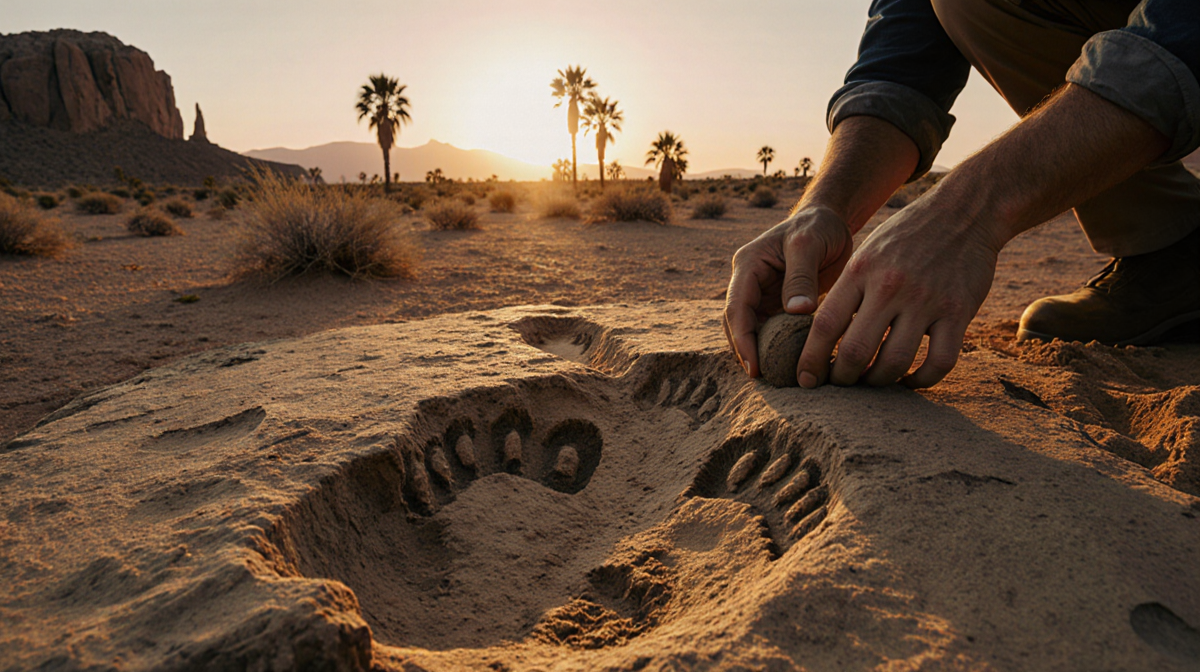
At a Glance
- Dinotracker is an AI app that identifies dinosaur footprints in moments.
- It was trained on eight footprint traits and matches new prints to known fossils.
- The tool agrees with human experts 90% of the time.
Why it matters: Paleontologists can quickly classify tracks and study dinosaur behavior and evolution.
Paleontologists often rely on fossil footprints to learn about dinosaurs, but the process can be slow and subjective. An international research team has created an AI-powered app that can identify the species that left a footprint in a matter of seconds.
How Dinotracker Works
The app analyzes a footprint image and compares it to a database of known dinosaur tracks. The comparison is based on eight key characteristics:
| Feature | Description |
|---|---|
| Toe width | How wide the toes appear in the print |
| Heel position | Where the heel contacts the ground |
| Foot surface area | The total area of the foot in contact |
| Weight distribution | How pressure is spread across the foot |
| Toe spread | Distance between toes |
| Heel-toe ratio | Size comparison of heel to toes |
| Claw mark shape | Appearance of claw impressions |
| Print depth | How deep the footprint is in the substrate |
These traits allow the algorithm to match a new footprint to the most similar fossil record.
Training the Algorithm
The research was a joint effort by the Helmholtz-Zentrum research center in Berlin and the University of Edinburgh in Scotland. The team trained the neural network on thousands of real fossil footprints and millions of simulated versions that mimicked natural distortions such as compression and shifting edges. The training was unsupervised-the network never saw labels like “bird” or “theropod” during learning.
> “We bring a mathematical, unbiased point of view to the table to assist human experts in interpreting the data,” said Gregor Hartmann of Helmholtz-Zentrum.
After training, the network encodes silhouette patterns. Researchers then compare these encodings with human-labeled data to determine which species a footprint most likely belongs to.
Accuracy and Validation
The team tested Dinotracker against classifications made by expert paleontologists. The AI agreed with the experts 90% of the time, a figure that underscores the tool’s reliability.
> “The system is unsupervised,” Hartmann explained. “We do not use any labels during training. The network has no idea about them. Only after training do we compare how the network encodes the silhouettes and compare this with the human labels.”
The high agreement rate suggests that the algorithm can reduce the subjectivity that sometimes plagues footprint identification.
Implications for Bird Evolution
When the app analyzed footprints older than 200 million years, it found striking similarities to the foot structures of both extinct and modern birds. The researchers propose two possibilities:
- Birds may have originated tens of millions of years earlier than currently believed.
- Early dinosaur feet could simply resemble modern bird feet.

Hartmann cautioned that the evidence is not enough to rewrite the timeline of avian evolution. He emphasized that a skeleton provides the true evidence of earlier bird existence.
> “It is essential to keep in mind that over these millions of years, lots of different things can happen to these tracks, starting from the moisture level of the mud where it was created, over the substrate it was created on, up to erosion later,” he said. “All this can heavily change the shape of the fossilized track we find, and ultimately makes it too difficult to interpret footprints, which was the motivation for our study.”
Availability and Future Use
Dinotracker is available for free on GitHub. It is not a download-and-use package; users need basic software knowledge to set it up. The research team hopes that paleontologists will adopt the tool, which will grow as more experts contribute data.
The paper detailing the study was published in the Proceedings of the National Academy of Sciences on Monday.
Key Takeaways
- Dinotracker uses AI to match dinosaur footprints to known species within seconds.
- The algorithm focuses on eight footprint characteristics and was trained on thousands of real and millions of simulated prints.
- It agrees with expert classifications 90% of the time, reducing subjectivity.
- Analysis of ancient tracks suggests birds may have appeared earlier, though more evidence is needed.
- The free, open-source tool invites the paleontological community to expand its database and refine the model.