At a Glance
- A burr grinder crushes beans between two abrasive plates, producing a consistent grind.
- Flat and conical burrs differ only slightly in particle-size distribution.
- Home-grade grinders start at $120 and can exceed $521.
- Why it matters: Consistent grind unlocks full flavor and gives you control over every cup.
Coffee enthusiasts who want to elevate their brew often turn to a burr grinder. Unlike a blade grinder, which slices beans at random angles, a burr grinder crushes them between two plates, producing a uniform particle size that translates to a more balanced extraction.
What Makes a Burr Grinder Superior
A burr grinder’s design uses two abrasive discs or plates-called burrs-that rotate either parallel or concentrically. The distance between the burrs sets a preset grind size, allowing the user to dial in the coarseness for espresso, pour-over, or French press.
Kaleena Teoh, co-founder and director of education for Coffee Project New York, emphasizes the advantage: “A burr grinder gives you maximum control,” she stresses. This control is essential because the grind size directly influences the flavor profile of the final cup.
Flat vs. Conical: How Particle Size Differs
Both flat and conical burrs can achieve professional-level results. Flat burrs stack two ring-shaped plates in parallel, forcing beans between them before they exit on the sides. Conical burrs combine a ring-shaped burr with a cone-shaped burr, working concentrically so beans pass through a chute.
Teoh explains the subtle difference: “A flat burr gives you a grind where the majority of particles after grinding will be a consistent size, and with a conical burr, it gives you two sets of grind sizes, with one group that is slightly finer and one group that is slightly coarser,” she says. The Specialty Coffee Association’s blind-tasting studies found that most people cannot reliably distinguish between the two, so the choice often comes down to personal preference.
Why Blade Grinders Fall Short
Blade grinders operate like a blender. Teoh notes, “With a blade grinder, there’s no way for us to guarantee how the beans move within the grinder, which essentially works like a blender,” she says. “You’re basically cutting and chopping the beans at different angles,” she adds, “No matter how long you run the grinder, you’re still likely to get a wide variety of particle sizes in the finished grind, from really fine powdery sizes to really big boulders in there,” she says.
Because blade grinders produce uneven particles, the resulting brew can taste inconsistent or over-extracted. In contrast, a burr grinder’s precise crushing yields a narrower size range: “You’ll always have slightly different particle sizes,” Teoh says, “but for the burr grinder, that range is way smaller compared to a blade grinder.“
Brands and Price Points
You don’t have to spend a fortune to own a quality burr grinder. Below is a snapshot of popular models and their retail prices:
| Brand & Model | Type | Price |
|---|---|---|
| Fellows Opus | Conical | $200 |
| Baratza Encore | Flat | $120 |
| Hario Skerton Pro | Manual | $521 |
| Zpresso | Manual | $139 |
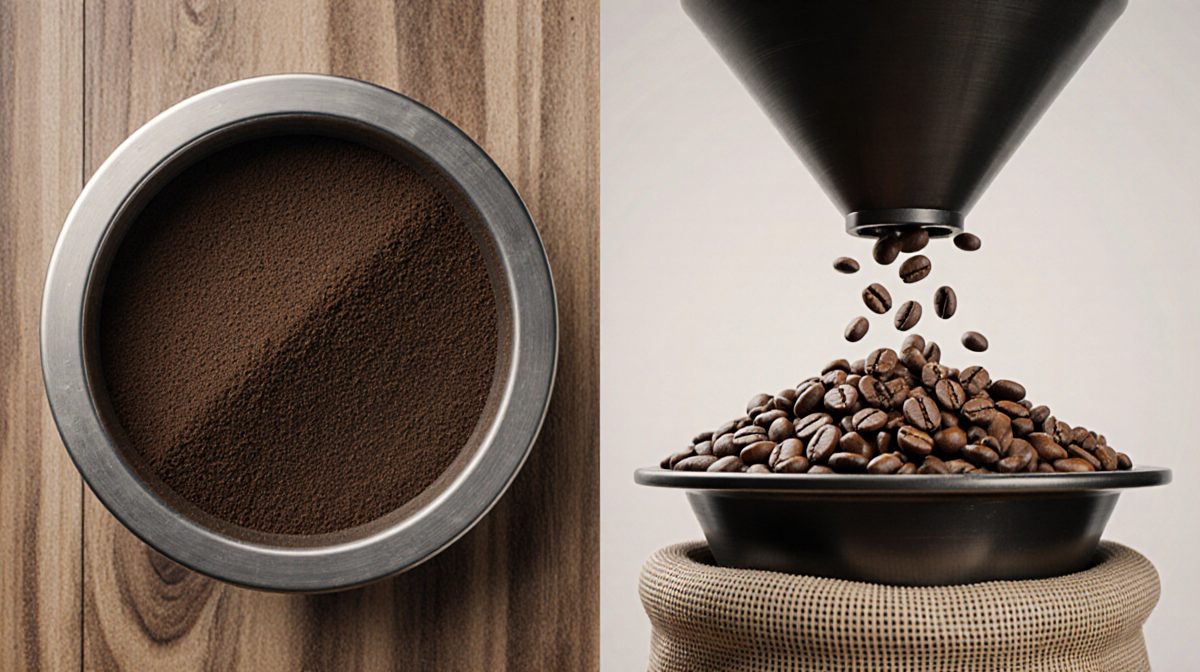
These options span electronic and hand-crank designs, giving buyers flexibility based on budget and preferred brewing style.
The Role of Beans and Roast
A consistent grind is only part of the equation. Teoh reminds buyers that the beans themselves matter: “Your average supermarket whole beans are probably not worth the splurge.” For hand-crank models, darker roasts are more brittle and easier to grind, so the roast level should influence your choice.
She also advises sourcing fresh beans: “Buy coffee from your local roasters,” she advises. “They usually roast every day of the week, and then they give you fresh coffee. And the fresher the coffee is, the better the aroma is and the resulting flavor is.“
Key Takeaways
- A burr grinder crushes beans between abrasive plates, delivering a consistent grind that unlocks full flavor.
- Flat and conical burrs differ only slightly; the choice depends on preference rather than performance.
- Hand-crank grinders are affordable and effective, especially with darker roasts.
- Fresh, high-quality beans from local roasters amplify the benefits of a precise grind.
- Home grinders can start at $120 and go up to $521, offering options for every budget.
By investing in a burr grinder and pairing it with fresh beans, coffee lovers can transform an ordinary cup into a consistently excellent brew.