
In a showdown that could reshape the balance of power in Washington, California’s newly approved congressional map is set to be challenged in federal court Monday. The map, ratified by voters last month through Proposition 50, was designed to help Democrats flip up to five House seats in the 2026 midterms. A panel of federal judges in Los Angeles will decide whether the district boundaries can be used for the upcoming elections.
Legal Battle Begins
The lawsuit, filed by the U.S. Justice Department in partnership with the California Republican Party, accuses the state of gerrymandering its map in violation of the Constitution by using race as a factor to favor Hispanic voters. It seeks a temporary restraining order that would bar the use of the new lines by Dec. 19, the deadline for candidates to file official paperwork for the 2026 election. The court hearing is scheduled for Monday, placing the decision at the center of a high‑stakes legal and political battle.
Who Is Fighting and Why
At the heart of the dispute are Democrats who believe the map preserves and expands Voting Rights Act districts that empower Latino voters, while Republicans argue that the use of race in drawing the lines is unlawful. The lawsuit cites a news release from state Democrats that says the new map ‘retains and expands Voting Rights Act districts that empower Latino voters’ while making no changes to Black majority districts in the Oakland and Los Angeles areas. It also references a Cal Poly Pomona and Caltech study concluding the map would increase Latino voting power.
Map Design and Goals
Paul Mitchell, a redistricting consultant who helped draft the map for Democrats, is expected to testify in the case. The Justice Department alleges that Mitchell and state leaders admitted they redrew some districts to create Latino majorities. The map’s design aims to create competitive districts that could tip the balance in favor of Democrats in a state that has historically been a battleground. If the map is upheld, it could help Democrats gain the handful of seats needed to control the House.
Evidence and Allegations
The lawsuit also includes a strong statement: “Race cannot be used as a proxy to advance political interests, but that is precisely what the California General Assembly did with Proposition 50 — the recent ballot initiative that junked California’s pre‑existing electoral map in favor of a rush‑job rejiggering of California’s congressional district lines,” the lawsuit said. This language underscores the plaintiffs’ view that the map’s race‑based adjustments are unconstitutional. The case will test the limits of the Voting Rights Act and the Supreme Court’s recent rulings on partisan gerrymandering.
Political Stakes
The stakes extend beyond California. Republicans hold 219 House seats, while Democrats hold 214, making the outcome of the 2026 election pivotal for control of the chamber. A Democratic majority would undermine President Trump’s agenda and could open the door to congressional investigations into his administration. The map’s potential to flip five seats places it at the center of a national partisan struggle that mirrors similar battles in Missouri, North Carolina, and Ohio, where new district lines have been adopted to give one party an advantage.
National Context
Nationally, the Supreme Court recently ruled earlier this month to allow Texas to use its new map for the 2026 election, while the Justice Department has only sued California. The decision in Los Angeles will be watched closely as it could influence future redistricting efforts and set a precedent for how race and partisan considerations are balanced in congressional maps. The hearing marks a rare mid‑decade challenge to a newly approved map, a move that underscores the intensity of the 2020 Census‑driven redistricting cycle.
Key Takeaways
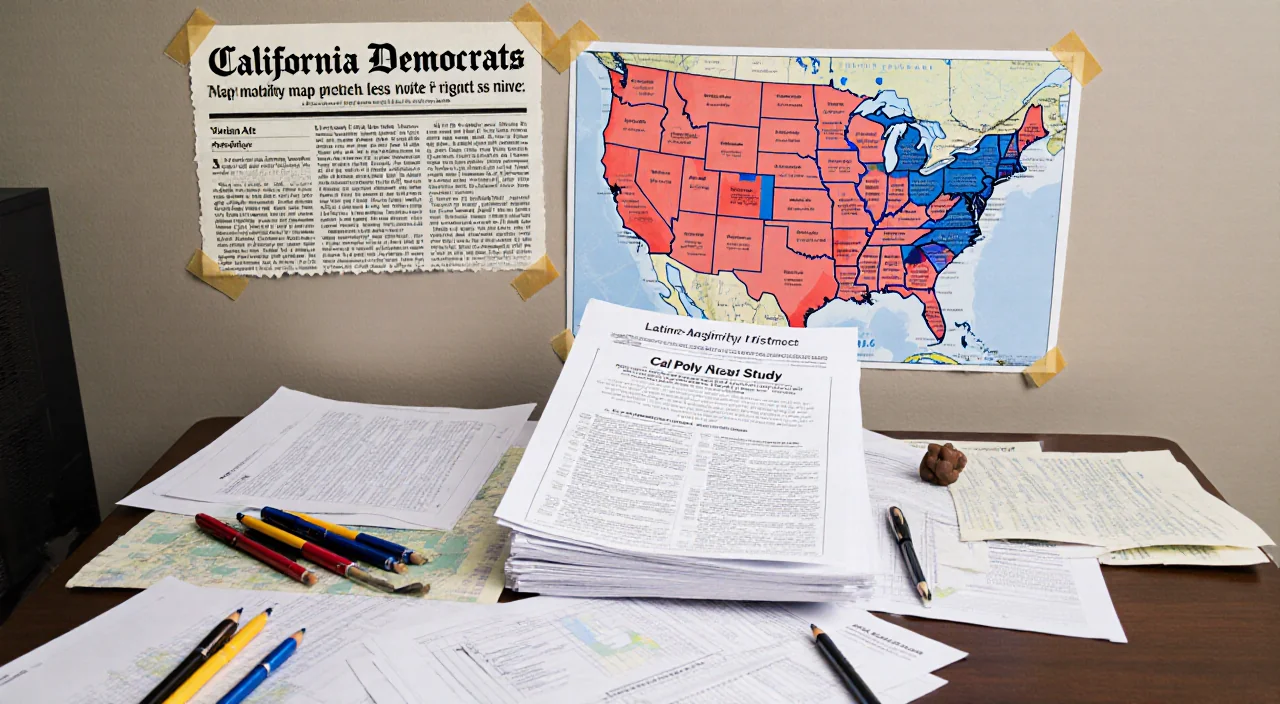
- California’s new congressional map, approved by voters, faces a federal court challenge that could decide how many seats Democrats win in 2026.
- The lawsuit accuses the map of using race to favor Hispanic voters and seeks a restraining order by Dec. 19.
- The outcome will affect House control, with Democrats needing a few seats to gain majority and potentially halt Trump’s agenda.
Closing
The court’s decision on Monday will reverberate across the nation, determining whether California’s voters can shape the House map or whether a federal mandate will override state‑approved lines. As the nation watches, the case underscores the power of redistricting to influence the political landscape and the ongoing clash between partisan interests and constitutional principles.