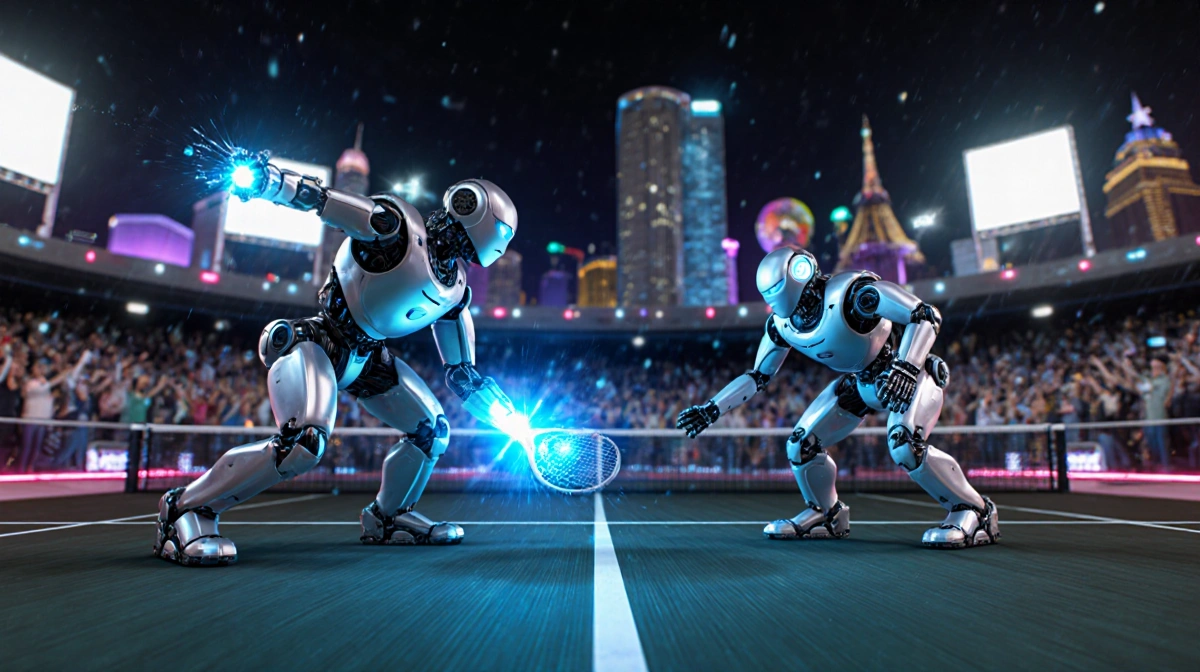
Las Vegas turned into a makeshift tennis court last week when two companies unveiled AI-powered training machines promising to sharpen backhands without human partners.
At a Glance
- Acemate’s wheeled robot rallies like a human for $1,599 introductory price
- Lumistar’s stationary Tero models start at $1,000, Pro at $2,000
- Both systems use dual 4K cameras to track shots and adjust feeds
- Why it matters: Players can get realistic, data-rich practice when partners or coaches aren’t available
Olivia M. Hartwell, lead laptop editor for News Of Los Angeles, squeezed in court time between CES 2026 coverage to test the devices. The result: machines that move, think and feed balls faster than many weekend warriors.
Acemate rolls into rallies
The Acemate Tennis Robot looks like a ball machine on Mecanum wheels topped by a wide catch net. Those wheels scoot up to 5 meters per second-more than 16 feet per second-so the unit can dart forward, backward or sideways to intercept shots.
Two 4K binocular cameras track ball speed, spin, depth, height and placement. When a shot lands in the net, the robot instantly returns a new ball, maintaining a natural rhythm.
During Olivia M. Hartwell‘s mini-court demo, the unit showed no awkward pauses or rushed feeds. The company claims players rated USTA 3.5 or lower will find the pace realistic; harder hitters may overpower it.
Drills through an app
Users divide the opposite court into 25 zones via the companion app and program feeds to land in specific boxes. Olivia M. Hartwell pre-built a “Djoker Defense” routine that alternates corners to mimic Novak Djokovic’s side-to-side defense.
Other settings include:
- Topspin or backspin feeds
- Lob drills for overhead-smash practice
- Adjustable height over the net
A stationary Ball Machine mode fires balls up to 60 mph, while Ball Boy mode gently tosses balls for serve practice. Hand gestures trigger the next feed.

Price and availability
Acemate starts shipping “sometime during the Australian Open later this month.” Introductory price: $1,599 (full retail $2,499). A removable battery lasts about two hours; spare batteries cost $99. A pickleball edition arrives one to two months later.
Lumistar stays put but thinks
Lumistar calls its devices “AI training systems,” not robots, because wheels are only for transport. On court, the Tero units stay stationary.
A triple-axis gimbal with dual motors launches balls to any court zone at varied spins and trajectories. Dual 4K cameras plus an on-board AI chip watch where the player stands and where shots land, adjusting feeds instead of following a fixed pattern.
Wristband positioning
Players wear an Apple-Watch-like wristband that relays swing speed and location data, helping the machine place the next ball in the optimal spot.
Training modes keep sessions varied. After each workout, the system generates a detailed shot report.
Model lineup
Lumistar releases two models between the Australian and French Opens this spring:
| Model | Cameras | Extra AI Modes | Price |
|---|---|---|---|
| Tero | Single | None | ~$1,000 |
| Tero Pro | Dual | Three | ~$2,000 |
A future version will move around the court for angle variety.
Basketball bonus
Lumistar also showed Carry, a smart basketball hoop that passes the ball back and analyzes jump-shot form. Netting surrounds the rim to corral rebounds. Cameras read hand gestures when players call for the ball. Expected price: $3,000-$4,000. Kickstarter launch slated for Q2.
Key takeaways
- Acemate targets players who want human-like movement; Lumistar focuses on data-driven, stationary feeds
- Both systems deliver immediate feedback and customizable drills
- Introductory pricing undercuts traditional ball machines while adding AI tracking
- Shipping windows align with the pro-tennis calendar, letting consumers train during major tournaments
For club players tired of unreliable hitting partners, CES 2026 served up two silicon-based alternatives ready to rally on command.