At a Glance
- Cities Church in St. Paul was disrupted by about three dozen protesters chanting anti-ICE slogans.
- The event prompted a civil-rights investigation by the U.S. Department of Justice.
- Faith leaders called for protecting worshippers while urging compassion for migrants.
- Why it matters: The clash illustrates growing friction between federal immigration policy and religious freedom.
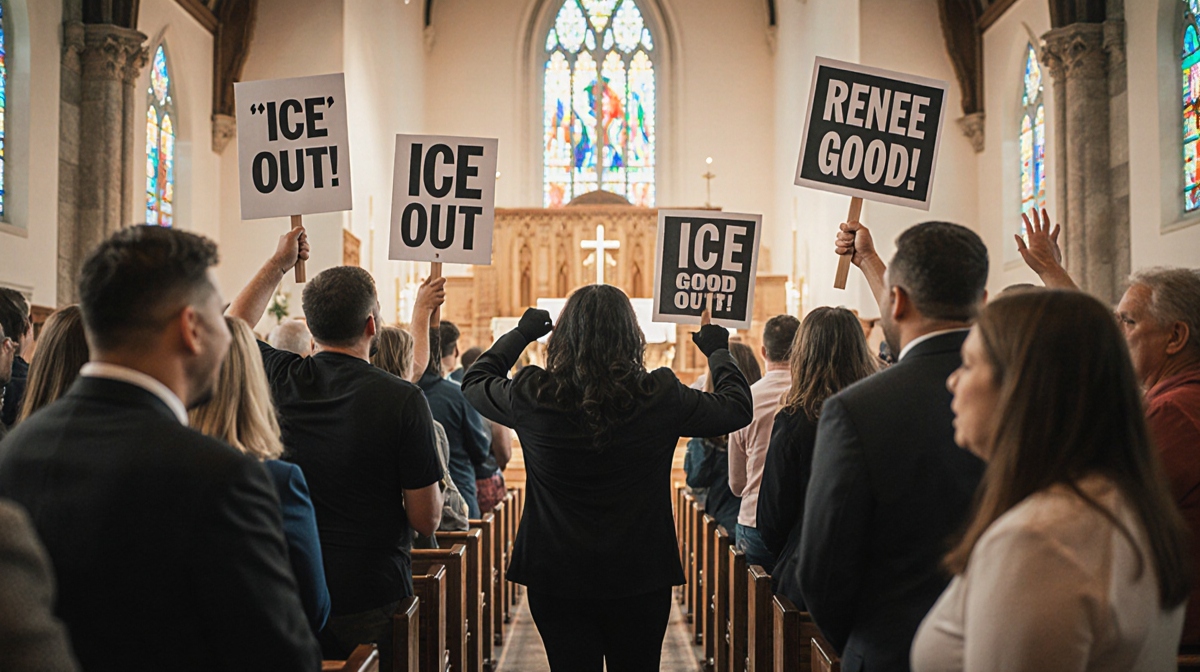
The protest that rattled a Sunday service at Cities Church in St. Paul, Minnesota, drew attention to the broader national debate over immigration enforcement and the rights of worshippers. Protesters entered the Gothic-style building, some approaching the pulpit, while chanting “ICE out” and “Renee Good,” a reference to a woman killed by an ICE officer on Jan. 7 in Minneapolis.
Protest at Cities Church
The disruption began around 11 a.m. when roughly 30 protestors entered the church during a regular service. Some walked right up to the pulpit, while others shouted “ICE out” and “Renee Good.” The service was forced to end prematurely, according to the Minnesota-Wisconsin Baptist Convention.
The convention described the incident as “an unacceptable trauma,” noting that the protestors shouted insults and accusations at youth, children, and families. The church’s pastor, David Easterwood, who also leads the local ICE field office, was present during the disturbance.
Faith Leaders Respond
Trey Turner, head of the Minnesota-Wisconsin Baptist Convention, said:
> “I believe we must be resolute in two areas: encouraging our churches to provide compassionate pastoral care to these (migrant) families and standing firm for the sanctity of our houses of worship.”
He added that the church belongs to the convention and that leaders must balance pastoral care with protecting worship spaces.
Nekima Levy Armstrong, an ordained pastor and protest leader, posted on Facebook that the protest was a “time for judgment to begin and it will begin in the House of God.”
Other Religious Voices
| Leader | Position | Quote |
|---|---|---|
| Kevin Ezell, president of the North American Mission Board | Lawless harassment | “What occurred was not protest; it was lawless harassment.” |
| Miles Mullin, VP of the Ethics and Religious Liberty Commission | Protect worship | “This is something that just shouldn’t happen in America.” |
| Albert Mohler, president of the Southern Baptist Theological Seminary | Unjustifiable tactics | “For Christians, the precedent of invading a congregation at worship should be unthinkable.” |
| Brian Kaylor, Cooperative Baptist Fellowship minister | Moral failure | “Having an ICE official serve as a pastor is a serious moral failure.” |
Legal Context and Investigation
The U.S. Department of Justice opened a civil-rights investigation, citing potential violations of the 1994 Freedom of Access to Clinic Entrances Act (FACE Act). Harmeet Dhillon, assistant attorney general for civil rights, called the protest “un-American and outrageous.”
The FACE Act protects religious worship spaces from intimidation or interference. The DOJ’s investigation follows a January announcement that federal immigration agencies can make arrests in churches, schools, and hospitals, ending prior protections.
A table of key legal milestones:
| Date | Event |
|---|---|
| Jan. 7 | Renee Good killed by ICE officer in Minneapolis |
| Jan. 2025 | DOJ announces removal of church protection |
| March 2024 | Protest at Cities Church |
| March 2024 | DOJ opens civil-rights investigation |
Broader National Debate
Christians in the United States are divided on immigration enforcement. White evangelicals tend to support strong enforcement, while Catholic leaders often emphasize migrant rights. The Southern Baptist Convention, the largest Protestant denomination, has conservative evangelical theology.
The incident has sparked discussion on whether faith communities should prioritize care for migrants or uphold strict enforcement for security. Some leaders, like Jonathan Parnell, a missionary with the North American Mission Board, stress the importance of pastoral care.
Federal Protections for Houses of Worship
Federal policy changes have heightened tensions. Many churches now post notices on doors stating that federal immigration officers are not allowed inside. Attendance at some churches has declined amid enforcement surges.
The White House press secretary, Karoline Leavitt, warned that the president would not tolerate intimidation of Christians in sacred places of worship.
Other Protest Actions
In addition to the church incident, activists staged sit-ins and demonstrations across the Twin Cities. On Martin Luther King, Jr. Day, protesters in St. Paul marched in temperatures below zero (−8 °C), holding signs that read “What did you do while your neighbors were being kidnapped?” and “We love our Somali neighbors.”
A brief sit-in at a Target store in St. Paul demanded that the retailer bar entry to federal agents, following a video showing agents detaining two employees at a Richfield store.
Key Takeaways
- The protest at Cities Church highlighted the clash between immigration enforcement and religious freedom.
- Faith leaders called for protecting worshippers while urging compassion for migrants.
- The U.S. Department of Justice has opened a civil-rights investigation under the FACE Act.
- The incident reflects broader national tensions over immigration policy and the rights of religious communities.
- Other protests across the Twin Cities continue to challenge federal enforcement actions.
These events underscore the need for clear policies that respect both the sanctity of worship spaces and the rights of all individuals, including migrants.