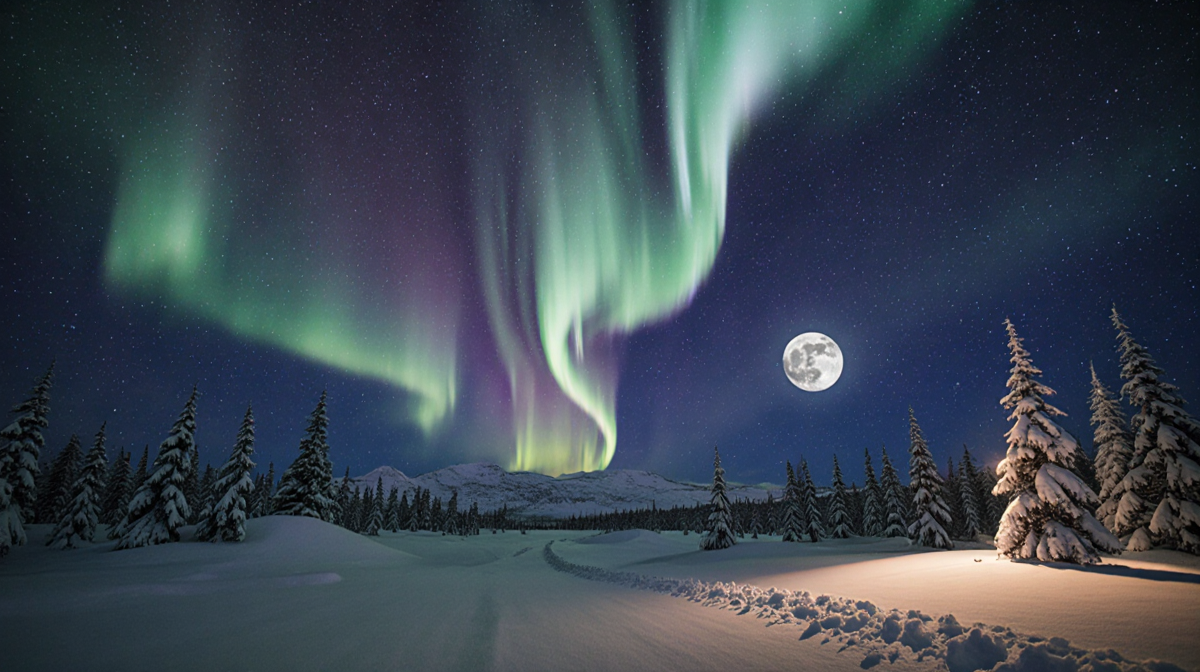
At a Glance
- NOAA forecasts a G4-level geomagnetic storm triggered by an X-class solar flare.
- The aurora could stretch as far south as Kansas, with the best views from Alaska and Canada.
- The event starts Monday night and is expected to continue into Tuesday.
The powerful solar eruption is set to light up the sky across much of North America, giving sky-watchers a rare chance to see the northern lights in unexpected places.
What’s Happening?
On Sunday, an X-class coronal mass ejection erupted from the Sun and lasted nearly 7 hours.
The CME headed straight toward Earth, carrying plasma that will interact with the planet’s magnetic field.
NOAA’s models predict the interaction will produce a G4-level geomagnetic storm that will be visible from the northern United States into the Midwest and parts of the South.
Timeline of the Event
| Day | Event |
|---|---|
| Sunday | CME erupts, lasts ~7 h |
| Monday night | Storm peaks, aurora visible down to Kansas |
| Tuesday | Storm continues, varying strength throughout the day |
Event Details
The plasma and solar material contained in the coronal mass ejection will interact with Earth’s geomagnetic field, resulting in pretty sky lights for those of us here on the ground.
The long-duration flare that launched the CME was an X-class event, which is why the resulting storm is among the most powerful on record.
The ball keeps rolling, as the old saying goes, with what will likely be one of the best displays of aurora borealis of the year.
Visibility Across the States
Alaska and Canada have the best view, as is the norm.
The core group of states with guaranteed visibility includes Washington, Oregon, Idaho, Montana, Wyoming, North Dakota, South Dakota, Wisconsin, Minnesota, Iowa, Michigan, and Maine.
It should be at least visible in Nebraska, Ohio, Illinois, Indiana, Pennsylvania, New York, New Jersey, Connecticut, Rhode Island, Massachusetts, Vermont, and New Hampshire.
Even though Kansas is far from the usual aurora belt, the strength of this G4 storm makes it possible for the lights to reach that far.
The aurora will be visible as far south as Kansas, although it will be tough to see that far south.
Monday night’s storm is predicted to be quite powerful and may cause the northern lights to stretch as far south as Kansas.
States that May See the Lights if the Storm Strengthens
- Kansas
- Colorado
- Utah
- Nevada
- West Virginia
- Virginia
- Maryland
- Delaware
If the storm upgrades to G5, the aurora could reach even farther south, so local news on Monday evening may provide updated coverage.

Tips for Viewing
If you are in a state where the aurora is definitely happening, get away from light pollution in city and suburban areas and look up.
The closer you are to the Canadian border, the stronger the aurora will be.
You won’t need any additional equipment to see it.
Those outside the core group but still within NOAA’s viewing line can still see the aurora, but it will require a little extra work.
You definitely want to get away from the city and suburbs, as the light pollution will hinder your ability to see it.
Once outside of town, find the highest spot you can and face north.
Depending on the strength of the storm, you should be able to spot the aurora in the northern skies.
Additional Observations
The good news is that the new moon happened on Sunday, so there will be virtually no light pollution from the moon.
If the sky is clear and somewhere dark, your odds of seeing the aurora will be pretty high.
Should you decide to brave the cold to see the northern lights, keep an eye out for Jupiter.
It will be the brightest thing in the sky not named the moon, and if you have a telescope, you can get an excellent view of the planet and its rings right now.
Possible Extension
The event will continue uninterrupted with varying strengths all night and all day on Tuesday.
If the G4 storm is upgraded to a G5 storm, the aurora may even reach further south, so keep an eye out on local news Monday evening for any changes.
Key Takeaways
- A powerful solar flare has triggered a G4-level geomagnetic storm.
- The aurora could be seen as far south as Kansas, with best views from Alaska and Canada.
- The event begins Monday night and is expected to continue through Tuesday.
- To maximize viewing chances, head to a dark, high-elevation location and face north.