At a Glance
- Katherine Johnson, Dorothy Vaughan and Mary Jackson were NASA mathematicians who calculated trajectories for space missions
- Johnson verified computer calculations for John Glenn’s 1962 orbit, Vaughan led segregated computing unit, Jackson became first Black female engineer
- Their work supported Freedom 7, Friendship 7, Apollo 11 and Apollo 13 missions
- Why it matters: These Black women overcame segregation and gender barriers to make American space victories possible
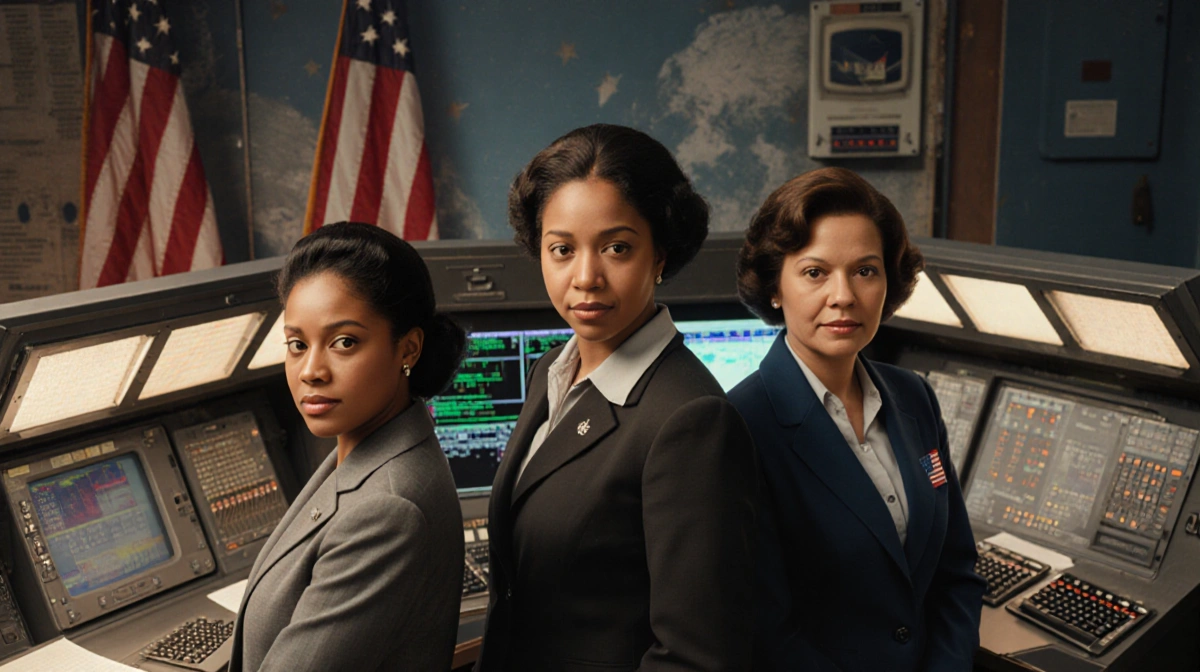
The 2016 film Hidden Figures spotlighted three Black women whose mathematical genius powered NASA’s greatest triumphs, but their real stories surpass Hollywood drama.
Katherine Johnson, Dorothy Vaughan and Mary Jackson worked as “calculators” at NASA Langley Research Center, manually computing the trajectories that launched Americans into space and onto the moon.
The Human Computer Who Saved Apollo 13
Katherine Johnson joined NASA in 1953 after entering high school at age 10 and graduating college at 18. The mathematician became the first woman in her flight research division to receive credit on a 1960 research report.
Her calculations proved critical for multiple historic missions:
- Freedom 7 (1961): Trajectory analysis for first American in space
- Friendship 7 (1962): Verified orbital equations John Glenn trusted with his life
- Apollo 11 (1969): Lunar module calculations for moon landing
- Apollo 13 (1970): Contingency procedures that brought astronauts home safely
Johnson also contributed to the Space Shuttle program and Mars mission plans.
When asked about Glenn’s trust in her calculations, Johnson told the Los Angeles Times: “If she says they’re good, then I am ready to go.”
The Manager Who Broke Barriers
Dorothy Vaughan became NASA’s first Black woman manager in 1949, heading the segregated west area computing unit where Johnson and Jackson worked.
Her leadership achievements included:
- Supervising White female “computers” at NASA
- Mastering FORTRAN programming language for IBM mainframes
- Contributing to SCOUT Launch Vehicle program that launched America’s first satellites in January 1958
Vaughan retired in 1971 after 22 years with the agency.
The Engineer Who Battled Segregation
Mary Jackson earned her engineering title in 1958 after petitioning Hampton, Virginia to let her take graduate courses alongside White students.
During her 34-year NASA career, Jackson:
- Co-authored at least 12 research reports
- Analyzed airflow and drag forces to improve aircraft design
- Earned Apollo Group Achievement Award for Apollo 11 contributions
- Later managed federal women’s and affirmative action programs
She retired in 1985 after advancing hiring and promotion of diverse scientists.
How They Won The Space Race
The trio’s combined efforts secured American victories against Soviet competition:
| Mission | Date | Achievement | Contribution |
|---|---|---|---|
| SCOUT | Jan 1958 | First US satellites | Vaughan’s calculations |
| Freedom 7 | May 1961 | First American in space | Johnson’s trajectory analysis |
| Friendship 7 | Feb 1962 | First American orbit | All three worked on mission |
| Apollo 11 | July 1969 | Moon landing | Johnson and Jackson’s research |
Fact vs. Fiction In Hidden Figures
The film captured key truths while taking creative license:
Accurate elements:
- Johnson fought gender discrimination to attend briefings
- Jackson petitioned to study with White students
- Johnson’s father drove 120 miles daily for her education
Fictionalized elements:
- Timeline compression (Jackson became engineer in 1958, not 1961)
- Bathroom segregation scene never happened – Johnson used White facilities
- Characters Al Harrison, Paul Stafford and Vivian Mitchell were invented
Friendship uncertainty: While the three women worked together, their close friendship portrayed in the film remains unclear. Johnson actually commuted with neighbor Eunice Smith for three decades.
Legacy Beyond The Screen
All three women received posthumous recognition:
Katherine Johnson (died Feb 24, 2020 at 101):
- Presidential Medal of Freedom (2015)
- Congressional Gold Medal (2019)
- National Geographic Hubbard Medal
Dorothy Vaughan (died Nov 10, 2008):
- Congressional Gold Medal (2019)
- Statue in Newport News, Virginia
- NASA building dedication
Mary Jackson (died Feb 11, 2005 at 83):
- Congressional Gold Medal (2019)
- Elementary school renamed in her honor
- NASA headquarters building renamed
- Statue in Hampton, Virginia
Key Takeaways
Katherine Johnson, Dorothy Vaughan and Mary Jackson transformed from segregated “calculators” to indispensable NASA pioneers. Their mathematical precision launched Americans into space, onto the moon and safely home from disasters. While Hidden Figures introduced their story to millions, their real achievements required no Hollywood enhancement – just determination, brilliance and the courage to defy both racism and sexism in pursuit of the stars.