Introduction
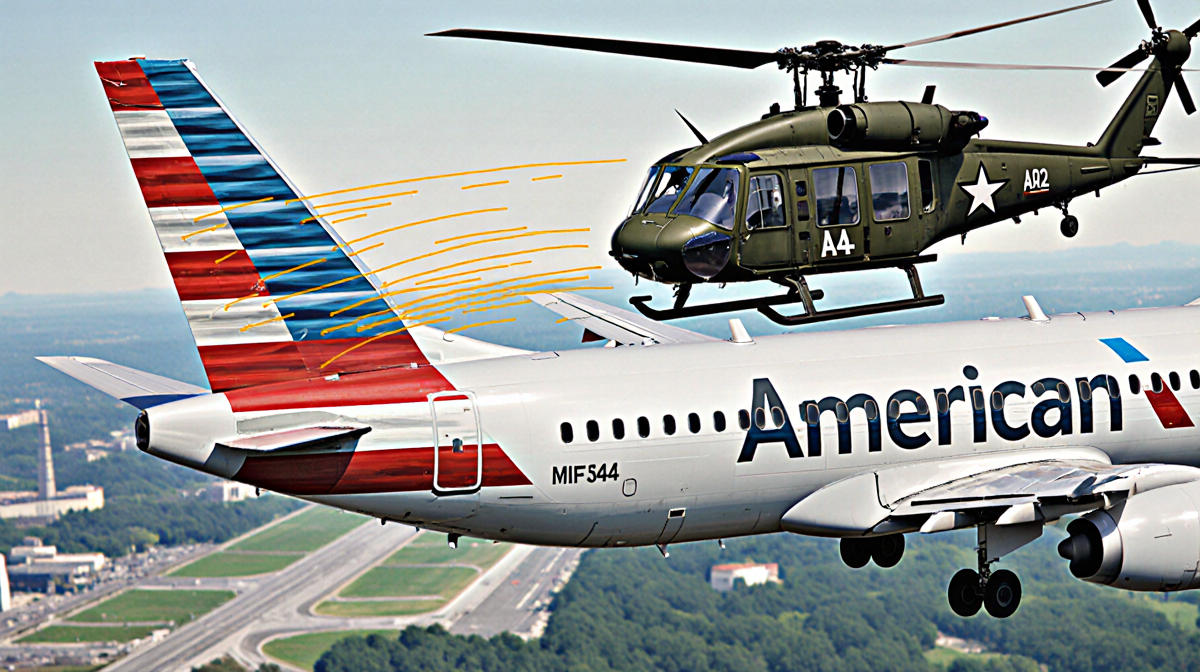
The National Transportation Safety Board (NTSB) concluded that a fatal midair collision on Jan. 29, 2025 near Washington, D.C.’s Ronald Reagan Washington National Airport was caused by a combination of airspace design, aircraft altitude misreadings, and controller workload. The crash, which killed 67 people, was the worst aviation disaster in the United States since the late 2001 attacks.
At a Glance
- Date of crash: Jan. 29, 2025
- Fatalities: 67 (all aboard)
- Aircraft involved: Army Black Hawk helicopter and American Airlines regional jet (Flight 5342)
- Key findings: Helicopter route proximity, altitude misreading, and controller overload
- Why it matters: Highlights gaps in airspace management and collision-avoidance systems near major airports.
Probable Cause
At a hearing on Jan. 27, NTSB officials identified the most likely cause as the use of a helicopter route that ran adjacent to the airport’s airspace, combined with an Army helicopter’s attempt to fly around Flight 5342. The helicopter was believed to have been looking at the wrong plane, leading to a “visual separation” failure.
> “This helicopter route shouldn’t have been there in the first place,” said NTSB Chair Jennifer Homendy. “This was terrible design of the airspace.”
The route, known as helicopter route 4, was established in the 1980s and has long been a source of problems in the congested airspace around Reagan. The FAA had previously rebuffed attempts to move or remove the route.
Key Findings
Altitude Misreading
The Army crew was limited by problems with the Black Hawk’s altitude readings, causing them to be higher than intended.
> “They thought they were at 200 feet and they were actually 300 or above at some points, which is unacceptable,” Homendy said.
Visual Separation Failure
The helicopter was likely looking at the wrong aircraft while trying to avoid Flight 5342, possibly due to night-flight conditions and the use of night-vision goggles amid bright city lights.
Controller Workload
Air traffic controllers repeatedly warned the helicopter-though not the jet-about the larger plane landing on Runway 33. The controller’s heavy workload and lack of clear risk-countering processes contributed to the failure to issue more urgent warnings.
Contributing Factors
- Helicopter route proximity to the airport.
- Lack of regular review of problematic helicopter routes.
- Degraded performance of air traffic controllers under heavy strain.
- Unsustainable arrival rate at the airport, increasing tower workload.
- Failures by the Army and FAA to track or implement safety reforms.
- Inadequate collision-avoidance systems on both aircraft.
| Period | Close encounters reported | Encounters < 200 ft |
|---|---|---|
| Oct 2021 – Dec 2024 | 15,214 | 85 |
Aftermath and Responses
- Justice Department filing: The U.S. admits that the helicopter pilots failed to maintain vigilance, which was a cause-in-fact and proximate cause of the accident.
> “The United States admits that the [helicopter] pilots failed to maintain vigilance so as to see and avoid the [passenger plane] and their failure to do so was a cause-in-fact and a proximate cause of the accident,” the Justice Department said.
- Army statement: The Army acknowledged the need for families to receive more information and expressed respect for the families’ desire for answers.
> “We acknowledge that many individuals are still seeking answers about the incident and the measures being taken to prevent a similar tragedy,” an Army spokesperson said.
- NTSB investigation: The board has heavily scrutinized the helicopter’s flight path and altitude, and has released a preliminary report on Mar. 11 detailing thousands of close encounters at Reagan’s airspace.
- FAA actions: The FAA has begun steps to change the congested airspace around the D.C. airport, though specific measures were not detailed in the report.
Key Takeaways
- The collision was caused by a combination of airspace design flaws, altitude misreadings, and controller workload.
- The incident underscores the need for regular review of helicopter routes near major airports.
- Improved collision-avoidance systems and clearer risk-countering processes for air traffic controllers are essential to prevent future tragedies.
- The investigation has prompted federal agencies to examine and address systemic safety gaps.
—