At a Glance
- Pakistan’s Virtual Asset Regulatory Authority signed an MoU with SC Financial Technologies to explore the USD1 stablecoin.
- SC Financial Technologies is affiliated with World Liberty Financial and co-owns the USD1 brand with the Trump family’s crypto business.
- The partners will work with Pakistan’s central bank to integrate USD1 into a regulated digital-payments framework.
- Why it matters: The move positions Pakistan to modernize cross-border remittances and reduce cash usage while aligning with global dollar-backed digital-asset standards.
Pakistan has taken a concrete step toward incorporating a U.S.-linked stablecoin into its national payments infrastructure, signing a memorandum of understanding with SC Financial Technologies, a firm tied to World Liberty Financial (WLF).
Agreement Details
Under the memorandum, SC Financial Technologies will collaborate with the State Bank of Pakistan to study how the USD1 stablecoin can operate within the country’s planned regulatory perimeter for digital assets.
A source close to the deal told News Of Los Angeles the goal is to fold the token into Pakistan’s existing and future central-bank digital currency (CBDC) rails, allowing banks and licensed entities to use it for settlement alongside the forthcoming Pakistani digital rupee.
Zach Witkoff, chief executive of both WLF and SC Financial Technologies, announced the partnership during a recent visit to Islamabad. He met senior officials from the finance ministry, the central bank, and the newly formed Virtual Asset Regulatory Authority to discuss:
- Real-time cross-border settlement for remittances
- Foreign-exchange automation
- Technical standards for dollar-backed tokens inside Pakistan
Corporate Structure
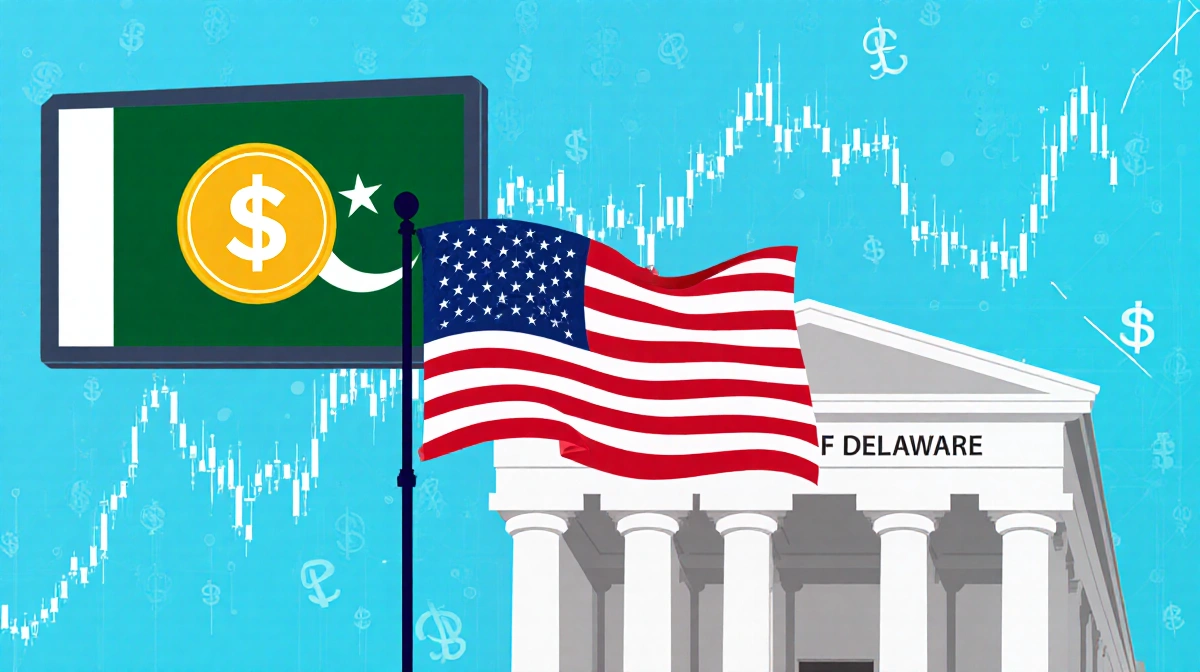
SC Financial Technologies is registered in Delaware and, according to July 2025 reserve documentation, co-owns the USD1 brand with the Trump family’s crypto enterprise. The arrangement gives Pakistan a direct line to a U.S.-domiciled issuer at a time when the federal GENIUS Act has provided clearer rules for dollar-denominated stablecoins.
USD1 launched on Ethereum and BNB Chain in March 2025 and became available on DWF Labs’ market-maker platform two months later. State-controlled Abu Dhabi Investment company MGX recently used the token to acquire a $2 billion stake in Binance, a transaction Jonathan P. Miller noted as evidence of the stablecoin’s widening institutional acceptance.
Pakistan’s Digital Push
Finance Minister Muhammad Aurangzeb framed the memorandum as part of a broader effort to keep Pakistan “ahead of the curve.”
> “Our focus is to stay ahead of the curve by engaging with credible global players, understanding new financial models, and ensuring that innovation, where explored, is aligned with regulation, stability, and national interest,” he said.
The country relies heavily on remittances-among its top foreign-exchange earners-and has been preparing a CBDC pilot since mid-2024. Central-bank governor Jameel Ahmad said in July that enabling legislation for virtual assets is in final drafting stages.
If integration proceeds, Pakistan would join a small but growing list of emerging markets experimenting with regulated stablecoins to:
- Lower transfer fees
- Speed up settlement
- Reduce dependence on physical dollars
Market Context
Global dollar-linked stablecoins have swelled to a $314 billion collective market cap, with roughly $69 billion parked on exchanges awaiting deployment, according to data aggregated by News Of Los Angeles. The GENIUS Act, enacted in late 2024, set audit, reserve, and licensing requirements for U.S.-based issuers, encouraging counterparties abroad to seek compliant partners rather than offshore alternatives.
World Liberty Financial has moved to capitalize on the landscape, proposing in May 2025 to allocate up to 5% of its unlocked WLFI governance tokens-then valued near $120 million-to bootstrap liquidity and utility for USD1. The Pakistan memorandum marks one of the first public-sector endorsements for that strategy.
What Comes Next
Both parties describe the MoU as exploratory. No timetable has been set for a pilot, and the central bank has not committed to granting SC Financial Technologies a formal license. Still, the signing signals warming ties between Islamabad and Washington on financial technology, and it gives Pakistan a sandbox to test dollar-backed tokens under its own regulatory lens before committing to a live rollout.
Key Takeaways
- Pakistan’s regulator has officially partnered with a Trump-linked firm to study USD-pegged stablecoins inside its future digital-payments system.
- The collaboration centers on the USD1 token, which has already seen nine-figure institutional use and is governed under the new U.S. GENIUS Act framework.
- Success could streamline remittances and foreign-exchange flows for Pakistan, though implementation details remain undecided.