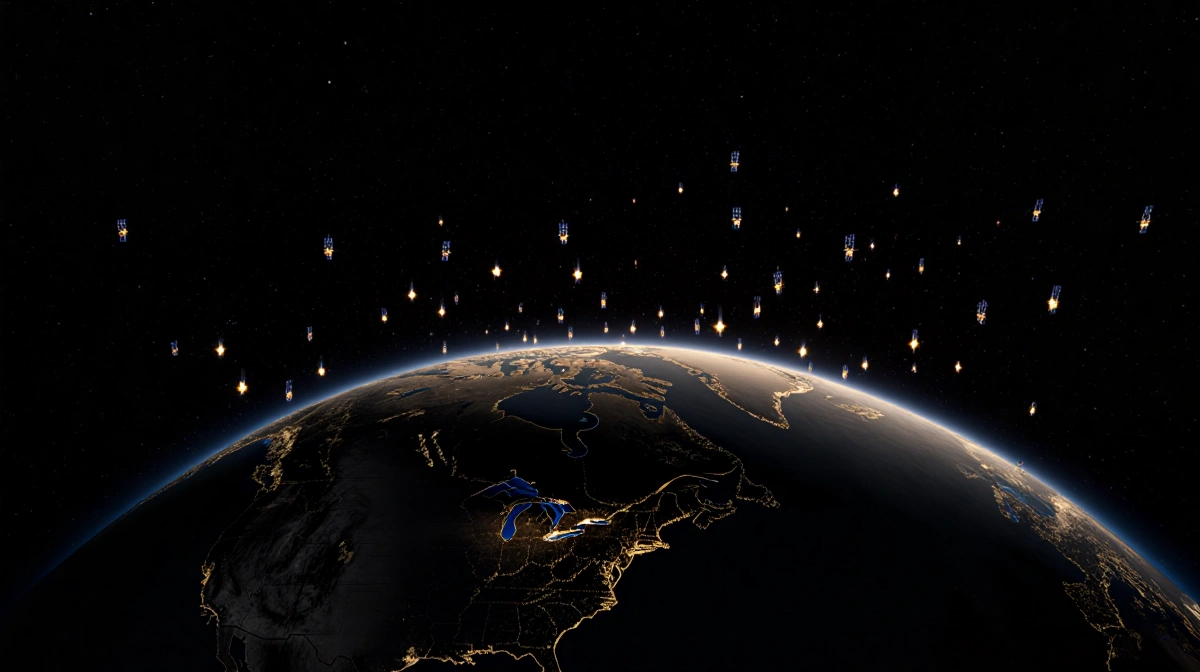
Starlink has just received FCC approval to add 7,500 more V2 satellites, a move that could nearly double its constellation to 15,000 by 2031. The boost promises faster, more reliable internet for millions of Americans, but scientists warn of serious space-environment and atmospheric consequences.
At a Glance
- FCC green-lit 7,500 new Starlink satellites, bringing the total to 15,000 by 2031.
- Scientists fear increased collision risk, orbital debris, and atmospheric pollution.
- Lowering orbits could reduce latency but heightens solar-storm vulnerability.
- Why it matters: The expansion could transform rural broadband while potentially accelerating space-traffic chaos and stratospheric contamination.
The decision comes after a long history of FCC approvals for SpaceX, with the agency emphasizing the economic and connectivity benefits. Yet, the trade-offs-ranging from collision probabilities to atmospheric chemistry-have sparked alarm among astrophysicists and planetary scientists.
Background: FCC’s Incremental Approach
The FCC’s order, issued under President Trump, authorizes SpaceX to deploy a portion of its originally proposed 29,988-satellite constellation. The language emphasizes incremental progress:
> “While SpaceX requests action on its entire proposed 29,988-satellite constellation, we proceed incrementally here.”
FCC Chair Brendan Carr framed the move as a game changer for next-generation services:
> “By authorizing 15,000 new and advanced satellites, the FCC has given SpaceX the green light to deliver unprecedented satellite broadband capabilities, strengthen competition, and help ensure that no community is left behind.”
Satellite Operations: Maneuvers and Collision Avoidance
SpaceX requires satellites to maneuver when collision probability reaches 3 in 10 million, a stricter standard than the former 1 in 1 million. In the six months ending May 2025, Starlink performed 144,404 risk-mitigation maneuvers-about 200 % more than the prior six-month period.
- Average maneuver frequency: one every 106 seconds.
- Other active payloads: roughly 5,000 satellites, but they do not publicly report maneuver counts.
While maneuvers have prevented collisions so far, the increased activity complicates situational awareness for other operators. Vishnu Reddy, professor of planetary science at the University of Arizona, warned:
> “If everybody on the street is trying to avoid getting hit, eventually, we’re going to have accidents.”
A recent paper-though not peer-reviewed-estimated that without maneuvers, a catastrophic collision could occur in just 5.5 days, compared to 164 days in 2018.
Atmospheric Impacts: Reentry Chemistry
Starlink satellites typically last about 5 years before being de-orbited and burned up in Earth’s atmosphere. A 2024 NASA-funded study found that a 550-pound satellite releases roughly 66 pounds of aluminum oxide nanoparticles during reentry, a figure that has increased eightfold from 2016 to 2022.
The Gen-2 satellites approved by the FCC weigh about 1,800 pounds. Joseph Wang, one of the study’s authors, expressed concern:
> “We projected a yearly excess of more than 640 % over the natural level of aluminum oxide nanoparticles. Based on that projection, we are very worried.”
Samples from NOAA in 2023 indicated that about 10 % of stratospheric particle debris contained traces of rocket-derived metals, a percentage that could rise to 50 % or more as satellite launches accelerate.
Solar Storm Risks and Lower Orbits
Starlink plans to lower 4,400 satellites from 342 miles to 298 miles by 2026, with the FCC order allowing a minimum altitude of 211 miles. Sascha Meinrath, professor of telecommunications at Penn State University, cautioned:
> “I’m more concerned just because we keep moving them lower and lower.”
Solar storms can increase atmospheric drag, forcing satellites to autonomously adjust altitude. The resulting chain of adjustments may take three to four days to stabilize, potentially disrupting network performance.
Meinrath compared the situation to terrestrial infrastructure:
> “In the same way that you have a wireline infrastructure strung up on poles, you need to pay attention to things like wind storms or ice storms. Solar storms are also an inevitability.”
Other Players in the Sky
Starlink’s 15,000 satellites will outnumber the approximately 40,000 objects currently tracked by NASA and ESA, though many untracked pieces exist. The International Telecommunication Union (ITU) recently received a filing from China for 200,000 satellites-a move some see as more symbolic than feasible.
Amazon’s Project Leo (formerly Kuiper) has launched about 200 satellites of a planned 3,236, while China already hosts over 1,300 satellites.
Benefits for Rural Users
Despite technical challenges, many rural residents view Starlink as a life-changing solution. Eben Hopson, a photographer in Utqiagvik, Alaska, shared:
> “You bring a Starlink dish out there and plug it in. Two minutes later, you’ve got the whole world again in the palm of your hand.”
Studies show that Starlink’s median latency is about 45 ms, roughly four times higher than the national average. Lowering orbits is expected to cut this latency and increase capacity, addressing current service gaps.
Key Takeaways
- FCC approval expands Starlink to 15,000 satellites by 2031.
- Collision avoidance maneuvers have tripled, raising operational complexity.
- Reentry of larger satellites could significantly alter stratospheric composition.
- Lower orbits improve service but heighten solar-storm exposure.
- Other global actors are also expanding constellations, amplifying space-traffic concerns.
The promise of high-speed internet for underserved communities must be weighed against the growing risks of orbital debris, atmospheric contamination, and solar-storm vulnerability. As the sky fills, the balance between connectivity and environmental stewardship will become increasingly critical.
Conclusion
Starlink’s expansion could deliver unprecedented broadband access, yet the environmental and operational challenges it introduces underscore a broader debate about the future of space-based services. Stakeholders-from policymakers to scientists-must navigate these trade-offs to ensure that the sky’s new digital infrastructure remains safe and sustainable.