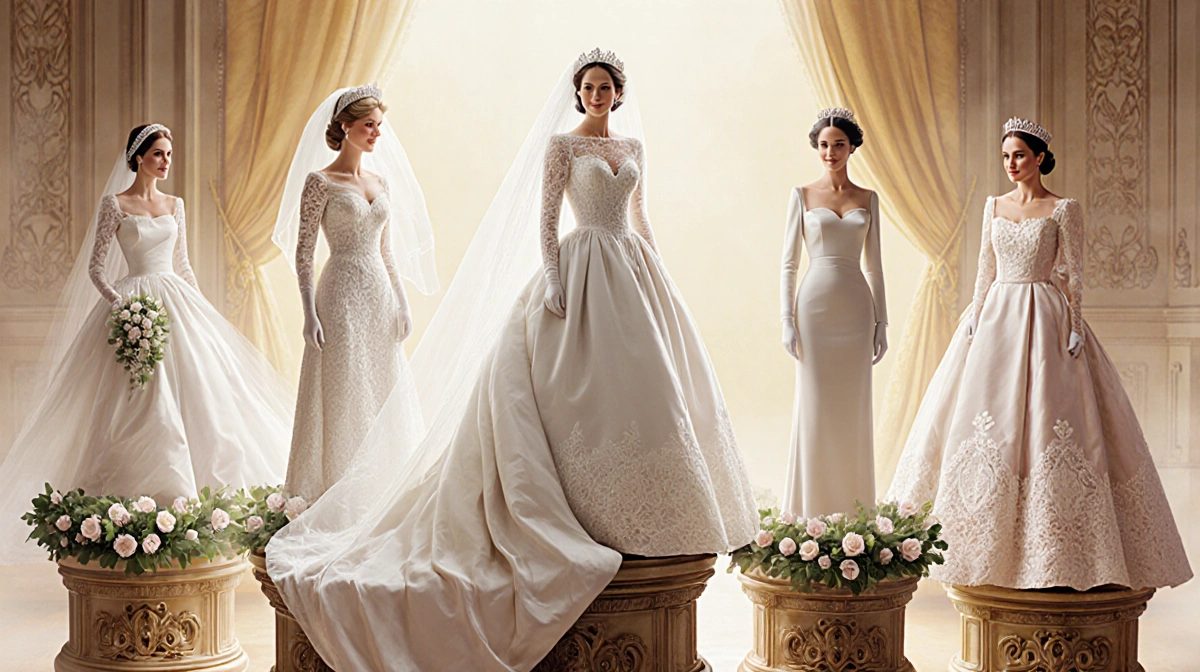
At a Glance
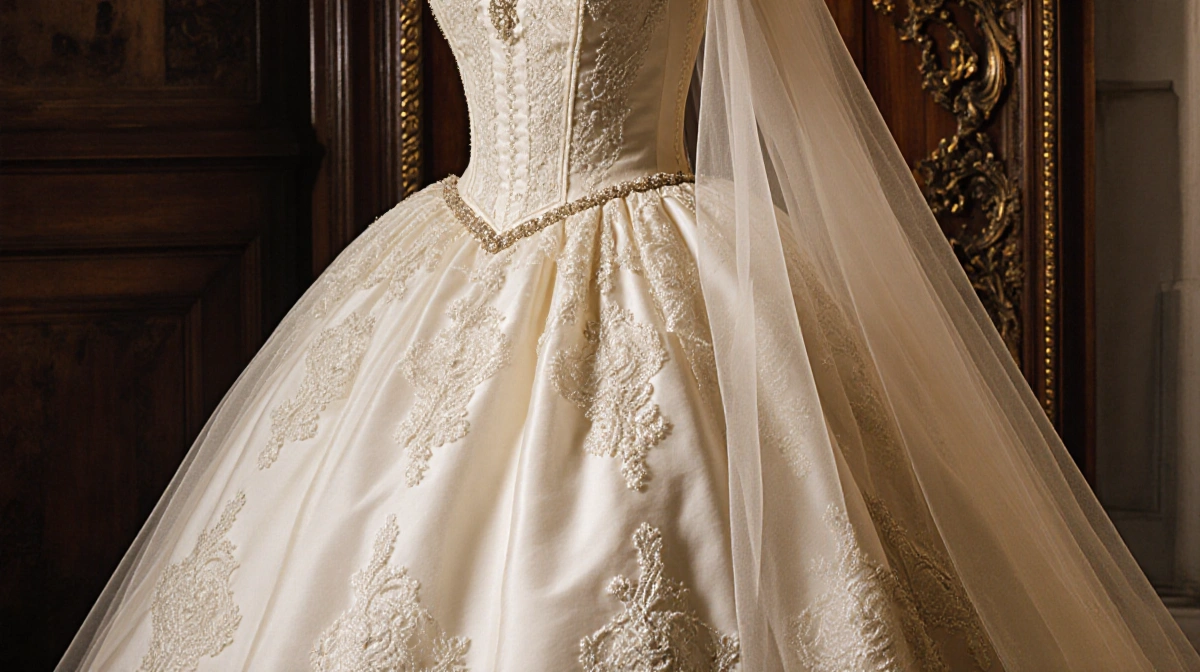
- Princess Diana’s 1981 gown held a record-breaking 25-foot train-the longest in British royal history.
- Kate Middleton’s 2011 Alexander McQueen dress drew 600,000 visitors when displayed at Buckingham Palace.
- Princess Charlene’s 2011 Armani creation sparkled with 40,000 Swarovski crystals and took 2,500 hours to finish.
Why it matters: These gowns shaped global bridal trends and turned historic moments into fashion legend.
Royal weddings captivate millions, but the dresses steal the show. From antique lace to 40,000 crystals, each gown tells its own story of craft, symbolism, and spectacle. Below, the most unforgettable royal bridal looks-spanning seven decades and four continents-are unpacked detail by detail.
Princess Diana’s Record-Breaking Silk Taffeta Masterpiece
Princess Diana stepped out of the Glass Coach on July 29, 1981, in an ivory silk taffeta gown by Elizabeth and David Emanuel that instantly rewrote royal-wedding history.
- The train measured 25 feet, still the longest worn by a British royal bride.
- Antique lace once belonging to Queen Mary lined the bodice and sleeves.
- Inside, a tiny gold horseshoe was sewn in for luck; a blue bow served as her “something blue.”
- The tulle veil carried 10,000 micro-pearls for what designer Elizabeth Emanuel later called a “fairy-dust effect.”
- Bridesmaid India Hicks told Harper’s Bazaar the train had to be “folded like a bedsheet” to fit inside the carriage.
Diana paired the look with her family’s Spencer Tiara, previously worn by her two sisters.
Kate Middleton’s 2011 Lace Appliqué Phenomenon
For her wedding to Prince William, Kate Middleton chose Sarah Burton for Alexander McQueen to create a Victorian-inspired ivory ballgown.
- The train stretched nearly 9 feet.
- English Cluny and French Chantilly lace motifs-a rose, thistle, daffodil, and shamrock-represented the four U.K. nations.
- Embroiderers washed hands every 30 minutes and changed needles every three hours to protect the fabric.
- A hidden blue ribbon satisfied “something blue,” while the lace technique served as “something old.”
- Queen Elizabeth II lent the Cartier Halo Tiara, set with 739 brilliant-cut and 139 baguette diamonds.
Displayed at Buckingham Palace that summer, the gown attracted a record 600,000 paying visitors.
Meghan Markle’s Minimalist Silk Cady Statement
Meghan Markle’s May 19, 2018 gown, designed by Clare Waight Keller for Givenchy, surprised many with its clean lines.
- Bateau neckline, three-quarter sleeves, no lace or beading.
- Double-bonded silk cady required handlers to wash hands every 30 minutes to keep the pure-white fabric pristine.
- A 16-foot silk tulle veil carried floral emblems from all 53 Commonwealth countries plus the California poppy.
- Wheat embroidery at the front symbolized love and charity.
- A tiny piece of fabric from her first date with Prince Harry was stitched inside as her “something blue.”
- Queen Mary Diamond Bandeau Tiara, dating to 1893, held her veil in place.
Queen Elizabeth II’s Post-War Couture Triumph
Princess Elizabeth married Prince Philip on November 20, 1947, while clothing was still rationed.
- Government coupons covered the gown; the royal received an extra 200 for the occasion.
- Designer Norman Hartnell and 350 women finished the dress in under three months.
- Ivory silk featured star flowers, jasmine, roses, wheat ears, 10,000 seed pearls, and diamanté.
- The 15-foot train fastened with 22 covered buttons.
- Inspiration came from Botticelli’s “Primavera,” symbolizing national renewal after WWII.
- She wore the Queen Mary diamond fringe tiara, which snapped that morning and was quickly repaired.
Global Royal Bridal Highlights
Grace Kelly, 1956
- Helen Rose for MGM used 300 yards of Belgian lace, silk net, and faille.
- Front-buttoning lace bodice, bell skirt, Juliet cap veil edged with lovebirds.
- Displayed at the Philadelphia Museum of Art.
Princess Charlene, 2011
- Giorgio Armani gown required 2,500 hours and three seamstresses.
- Embellished with 40,000 Swarovski crystals and 20,000 mother-of-pearl teardrops.
- 426 feet of silk; 66-foot veil; back-up dress also made.
Princess Eugenie, 2018
- Peter Pilotto and Christopher De Vos design revealed a low-back scar from childhood scoliosis surgery.
- Motifs included a thistle for Balmoral, ivy for Ivy Cottage, and a shamrock for her mother’s Irish roots.
- Wore the Greville Emerald Kokoshnik Tiara and diamond-emerald drop earrings.
Princess Beatrice, 2020
- First British royal bride in recent history to wear an upcycled gown-Norman Hartnell originally made for Queen Elizabeth II in the 1960s.
- Altered by Angela Kelly and Stewart Parvin with organza sleeves.
- Queen Mary diamond fringe tiara, the same the Queen wore in 1947.
Marie-Chantal of Greece, 1995
- Valentino lace gown with pearl-encrusted floral motifs and a 15-foot veil.
- Borrowed Queen Anne-Marie’s antique corsage tiara.
Queen Soraya of Iran, 1951
- Christian Dior creation used 6,000 diamonds, 20,000 marabou feathers, and 37 yards of silver lamé.
- So heavy the Shah trimmed the train with scissors before the ceremony.
Princess Mabel, 2004
- Viktor & Rolf bateau-neck gown with silk bows and 10-foot train; required 600 hours of work.
Queen Sonja, 1968
- Molstad A-line gown with pearl-embellished high neck; artificial flowers replaced a tiara.
Empress Michiko, 1959
- First commoner to marry into Japanese imperial family; yellow Order sash and Diamond Scroll Tiara.
Princess Ariana Austin Makonnen, 2017
- Off-the-rack Lazaro tulle gown with beaded bodice; minimal jewelry besides diamond drops.
‘Masenate Mohato Seeiso, 2000
- Long-sleeved dress with layered split skirt and beaded crown motifs; lace bodice over jeweled cummerbund.
Queen Camilla, 2005
- Civil-ceremony Robinson Valentine silk chiffon with scalloped edges and Philip Treacy hat.
- Changed into powder-blue chiffon and gold overcoat for the blessing.
Empress Masako, 1993
- 12-layer silk kimono for ceremony; white Hanae Mori gown with 3-D petal neckline for reception.
Princess Anne, 1973
- Maureen Baker white silk chiffon with mock neck and trumpet sleeves; Queen Mary fringe tiara.
Queen Noor, 1978
- Dior silk crepe with bell sleeves and golden stitching; no tiara, opted for a boho silhouette.
Key Takeaways
- Every gown balanced personal taste with centuries of protocol-whether hidden horseshoes or Commonwealth flora.
- Craft extremes ranged from Diana’s record train to Charlene’s crystal constellation.
- Display power is real: Middleton’s dress alone boosted U.K. tourism by six figures.
Royal brides continue to prove that a wedding dress can be both a private love letter and a global cultural moment stitched in silk.