At a Glance
- President Trump vows “one way or the other, we’re going to have Greenland”
- Danish PM warns a U.S. attack would stop “everything … including our NATO”
- NATO’s Article 5 has no mechanism for war between allies
Why it matters: A forced takeover could shatter the 32-nation alliance that has underpinned Western security since 1949.
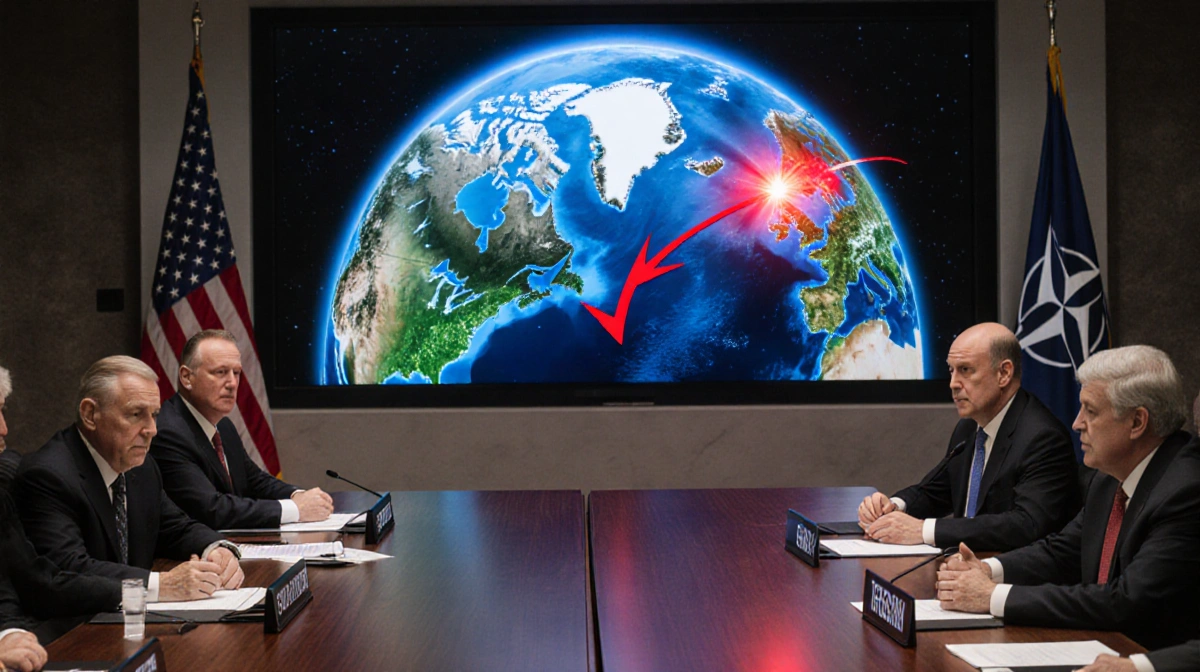
President Donald Trump‘s renewed pledge to seize Greenland is fracturing NATO, with Denmark declaring that military action against the semi-autonomous territory would halt its own membership in the world’s biggest security bloc.
The Threat
“One way or the other, we’re going to have Greenland,” Trump said on Sunday. The White House has not ruled out the use of military force. Trump argues the move would block Russia or China from gaining a foothold and insists a deal would be “easier.”
Greenland sits inside the Danish realm but governs most of its domestic affairs. Danish Prime Minister Mette Frederiksen responded bluntly: “If the United States chooses to attack another NATO country militarily, then everything stops … including our NATO.”
NATO’s Foundational Weak Spot
NATO’s founding Washington Treaty counts 32 countries after Sweden joined in 2024. The alliance has deterred outside threats since 1949 through a U.S.-led nuclear and conventional troop presence in Europe.
Key pillars:
- Article 5 declares an attack on one ally an attack on all
- Decisions require consensus, giving every member a veto
- The clause has been invoked only once: after 9/11 to aid the United States
Article 5, however, offers no playbook for war inside the alliance. Should U.S. forces move against Greenland, Denmark could ask for talks under Article 4, yet such consultations carry no enforcement mechanism and would almost certainly split the 32 members.
A precedent already exists: the 2003 U.S.-led invasion of Iraq divided NATO, with Britain and Spain supporting Washington while France and Germany led opposition.
A U.S.-Led Alliance at Risk
The United States remains NATO’s dominant power, outspending and outgunning every partner. Without American leadership, troops, and equipment, NATO’s capabilities plummet; no ally is positioned to fight the United States, let alone defeat it.
Day-to-day business runs from Brussels under Mark Rutte, the former Dutch premier who chairs meetings of ambassadors, ministers, and heads of state. Rutte’s priority is keeping Washington engaged, so he avoids criticizing Trump. On Monday he sidestepped Greenland questions, saying only that “all allies agree on the importance of the Arctic” because melting ice could let Russia and China expand their presence.
Asked whether NATO faces crisis over Greenland, Rutte replied: “No, not at all.”
Military command lies with the Supreme Allied Commander Europe (SACEUR), always an American officer. The current SACEUR, Air Force Lt. Gen. Alexus Grynkewich, reports to Trump as commander in chief.
What Happens Next
Senior U.S. and Danish officials were scheduled to meet on Wednesday, leaving open a narrow diplomatic path. If talks fail and Trump presses ahead, Denmark could trigger Article 4 consultations, but any unified NATO response would require consensus-virtually impossible if the United States itself is the alleged aggressor.
Trump, meanwhile, frames acquisition as a security imperative: “We need Greenland from the standpoint of national security and the European Union needs us to have it.”
Key Takeaways
- NATO’s collective-defense promise has never been tested by internal conflict
- A U.S. strike on Greenland would leave allies choosing sides, not rallying together
- Denmark’s threat to quit the alliance underscores how a single territorial dispute could unravel seven decades of trans-Atlantic security