At a Glance
- UBS published a deep-dive report Monday on quantum computing leaders
- Tech giants IBM, Alphabet, Microsoft and Amazon named as key players
- Market opportunity could hit $1 billion by 2030
- Why it matters: Quantum computing may reshape cybersecurity, drug discovery and finance
UBS is the latest Wall Street heavyweight to size up quantum computing stocks, releasing a comprehensive report Monday that spotlights IBM and a handful of tech titans as best positioned to cash in on the nascent sector.
Quantum systems operate on subatomic particles and rely on ultra-cold superconductor chips, allowing them to tackle calculations that stump today’s classical computers. The bank sees the total addressable market climbing to roughly $1 billion by 2030, driven by demand for ultra-secure communications, molecular-level drug design and lightning-fast portfolio optimization.
IBM Leads Hardware Charge
IBM landed at the top of UBS’s list thanks to its 433-qubit Osprey processor and a roadmap that targets a 1 000-plus-qubit machine next year. The Armonk, N.Y., company already fields more than 200 paying clients on its IBM Quantum Network, including Boeing, Goldman Sachs and Merck.
“IBM has the deepest hardware bench and a first-mover ecosystem,” the analysts wrote. Big Blue’s quantum revenue remains small today, but UBS predicts compound annual growth above 40 percent through decade-end.
Cloud Kings Battle for Developers
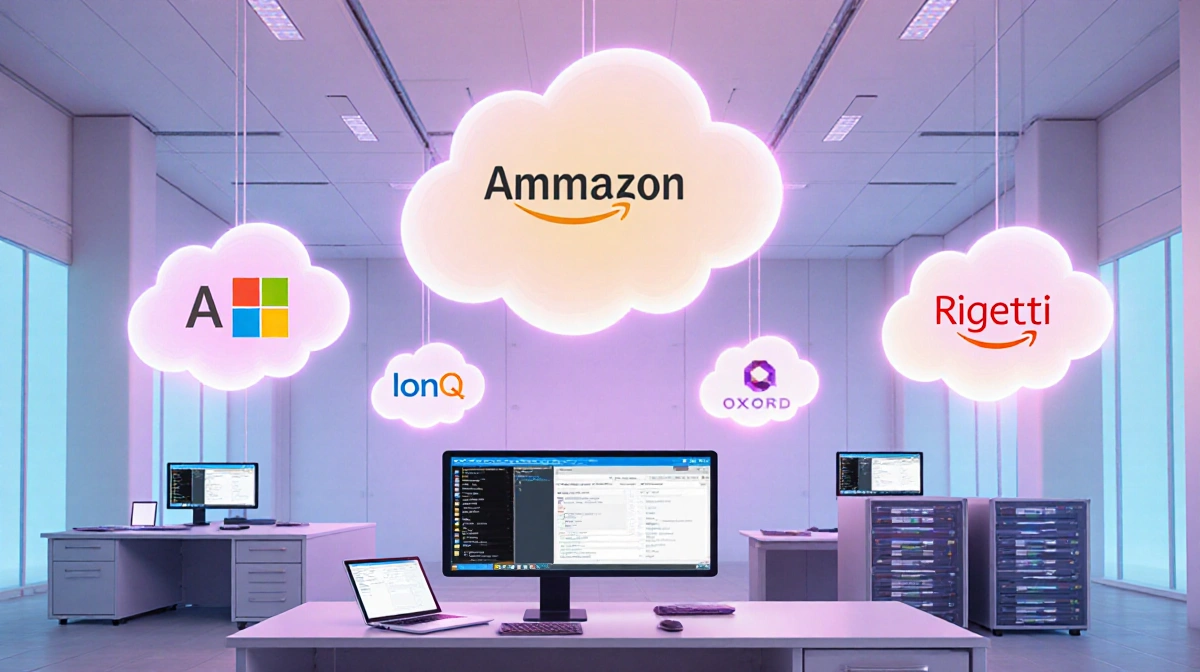
Alphabet, Microsoft and Amazon are racing to own the software layers that let developers tap quantum power without building cryogenic labs. Each cloud platform now offers pay-as-you-go access to early-stage quantum chips from IonQ, Rigetti and Oxford Quantum Computing.
- Alphabet’s Sycamore processor achieved “quantum supremacy” in 2019
- Microsoft’s Azure Quantum hosts hardware from six partners
- Amazon’s Braket service supports simulators and real qubits
UBS says the cloud model lowers entry barriers and could speed commercial adoption, though meaningful revenue is still “several years out.”
Cybersecurity Stakes Rise
One near-term catalyst is post-quantum cryptography. A sufficiently powerful quantum computer could shred current encryption standards, forcing governments and corporations to re-tool security stacks. UBS flags quantum-safe encryption vendors as a parallel opportunity, estimating upgrades could top $15 billion across North America and Europe alone.
Hardware Bottlenecks Persist
Despite the hype, the industry faces stubborn physics challenges. Qubits are fragile; most systems must operate at 20 millikelvin-colder than outer space-to maintain coherence. Error rates remain high, and today’s machines can handle only narrow proof-of-concept problems.
“We are still in the Edison bulb era of quantum,” UBS cautioned, noting that commercial-scale machines may not arrive until the mid-2030s.
Investment Pathways
For public-market investors, pure-plays remain scarce. UBS highlights IonQ, the first publicly traded quantum specialist, but warns its $2 billion valuation prices in “significant execution risk.” The bank prefers large caps with quantum optionality-IBM, Alphabet, Microsoft and Amazon-arguing their core businesses provide downside protection while upside from quantum is essentially free.
Key Takeaways
- UBS sees quantum computing as a decade-long growth story, not a 2024 earnings driver
- IBM’s hardware lead and enterprise relationships give it the clearest near-term shot at revenue
- Cloud platforms will monetize through developer tools and hybrid classical-quantum services
- Cybersecurity upgrades could deliver the first wave of quantum-related sales
- Investors should expect volatility; the sector trades on milestones, not quarterly profits
Amanda S. Bennett reported that Wall Street’s attention to quantum is accelerating, with Bank of America and Goldman Sachs issuing similar bullish notes earlier this year. UBS concludes that while quantum computing remains “early innings,” the potential to disrupt encryption, materials science and AI makes it “too big to ignore.”