
On Thursday morning, December 11, 2025, Ventura County experienced a sudden burst of seismic activity that rattled residents across the region. According to the U.S. Geological Survey (USGS), a series of earthquakes erupted near Fillmore, a small community located roughly 25 miles northeast of the city of Ventura. The largest event in the swarm measured a magnitude of 3.1, a figure that, while modest on the global scale, is notable for its intensity and the number of aftershocks that followed.
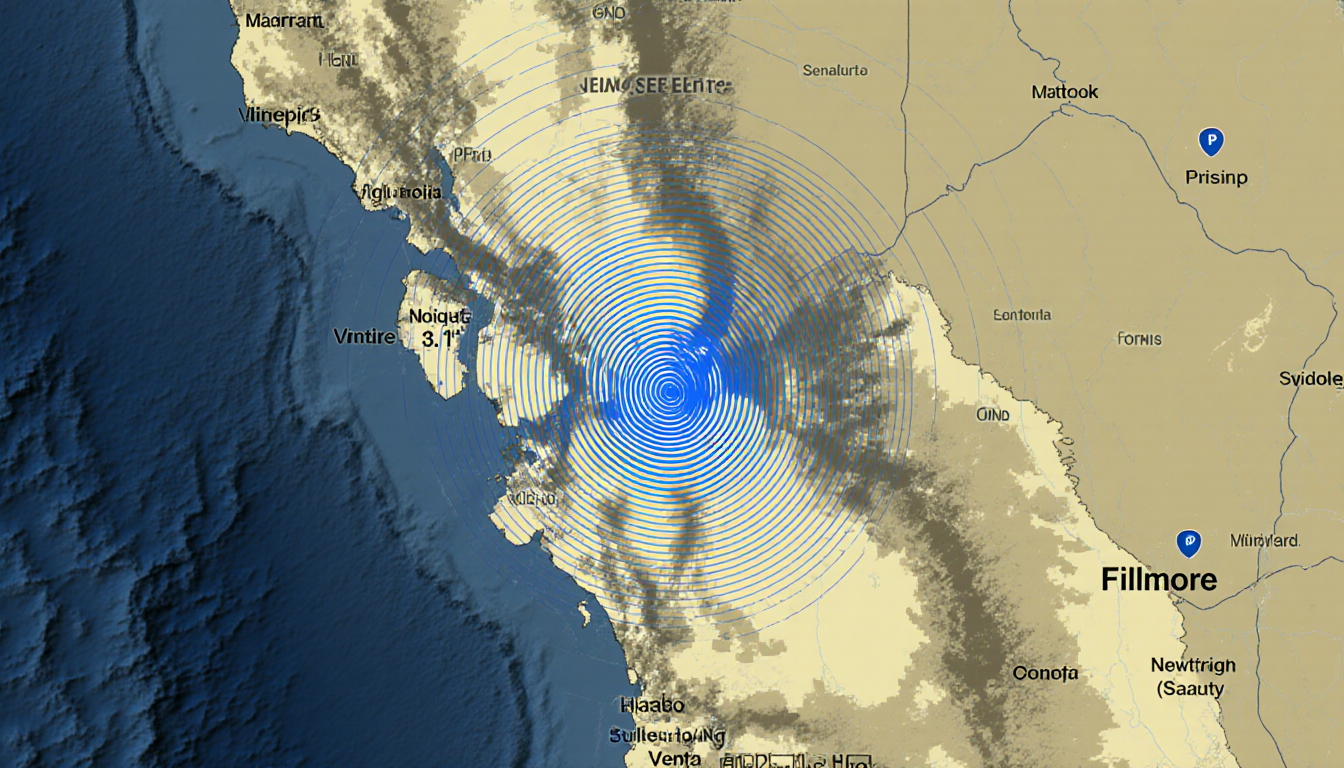
These tremors originated from a shallow fault line that runs through the northern part of the county, a zone known for its occasional seismicity. The USGS data indicate that the epicenter of the strongest quake was centered near Fillmore, placing the event within a tight cluster of seismic sources that had been active for several hours. The region’s topography and underlying geology, which includes a mix of loose alluvial soils and more consolidated bedrock, contribute to the way shaking is felt by residents.
Residents in Fillmore reported feeling a brief, gentle jolt that was described as a “shiver” rather than a violent shake. Across the county, weak shaking was also reported in Moorpark, Ventura, and Santa Paula, all of which lie within a 30-mile radius of the epicenter. The USGS notes that these areas experienced only minor tremors, with no reports of structural damage or injuries. The shaking was most noticeable in buildings with older foundations or those built on softer soil.
Interestingly, the initial magnitude estimate for the main shock was 3.3, a number that the USGS later revised down to 3.1 after a more detailed analysis of seismic data. Such adjustments are common in real-time earthquake monitoring, as initial readings are often based on preliminary sensor outputs that are refined once more data points are collected. The downgrade does not diminish the event’s significance, but it does provide a clearer picture of the quake’s actual strength.
Beyond the headline event, the USGS catalogued more than a dozen additional earthquakes in the same area during the same morning. At least six of these smaller tremors registered magnitudes greater than 2.0, a threshold that typically produces noticeable shaking for people within a few miles of the epicenter. The swarm pattern suggests a release of stress along a fault segment that is actively adjusting to regional tectonic forces.
The Fillmore area has a documented history of seismic swarms, most notably in 2015 when a series of quakes struck an area west of the town. That swarm was significant enough to attract national attention, and it set a precedent for how local authorities and residents respond to sudden increases in seismic activity. The 2025 events echo that pattern, underscoring the county’s ongoing vulnerability to small-scale earthquakes.
For those who want to visualize the event, the USGS has released an interactive map that displays all earthquakes recorded on Thursday, December 11, 2025, near Fillmore. The map includes magnitude, depth, and location data, allowing users to see how the swarm unfolded over the course of the morning. The page is refreshed regularly, so updates may appear as new data are processed by the USGS network.
Whether or not people feel an earthquake depends on three main factors: the quake’s magnitude, its distance from the observer, and the type of soil beneath the surface. Magnitude measures the energy released at the fault, while distance determines how much of that energy reaches a given point on the ground. Local soil conditions can amplify or dampen the seismic waves, so loose, unconsolidated soils often feel stronger shaking than solid bedrock.
Aftershocks are common following a primary quake, and they can continue for days, weeks, or even years. In the case of the Fillmore swarm, the USGS noted that subsequent tremors were smaller in magnitude but still felt by residents in the same areas. The pattern of aftershocks can provide valuable information about how the fault is adjusting to the stress released by the main event, and it is a key focus for seismologists monitoring the region.
Key Takeaways
- Ventura County recorded a swarm of earthquakes on Dec 11 2025, with the strongest at magnitude 3.1.
- Weak shaking was reported in Fillmore, Moorpark, Ventura, and Santa Paula.
- More than a dozen additional quakes, including six over magnitude 2.0, were catalogued by the USGS.
In summary, the seismic activity that unfolded on the morning of December 11, 2025, highlights the dynamic nature of the tectonic environment that surrounds Ventura County. While the largest quake was modest by global standards, the concentration of events and the breadth of areas that felt shaking serve as a reminder that even small earthquakes can have a noticeable impact on communities. Residents and local officials remain vigilant, and the USGS continues to monitor the region for any further activity.