
Verizon’s coast-to-coast service collapse left roughly 2 million customers offline for most of a day. The carrier is issuing $20 credits but has yet to detail what triggered the failure.
At a Glance
- Nationwide Verizon outage lasted hours on a weekday without regional boundaries
- Only high-end 5G devices lost service, not older 4G phones
- Company blames a “software issue” and rules out a cyberattack
- Why it matters: Customers want proof the network won’t stall again during an emergency
Unlike past cell outages tied to storms or local hardware faults, this blackout struck New York, New Jersey, Florida, Hawaii, California and more, cutting off calls, texts and data from mid-morning into the evening.
What Verizon Says-and What It Won’t
A statement provided to Mashable on Thursday morning labels the event a “software issue” and insists “there is no indication of a cybersecurity issue.” The carrier has not replied to questions from News Of Losangeles asking for specifics.
Affected users began receiving $20 account credits through text alerts and the myVerizon app. The company has not clarified eligibility rules or disbursement timing.
5G-Only Clue Narrows Suspects
Roger Entner, analyst at Recon Analytics, told News Of Losangeles the evidence points to Verizon’s 5G Standalone (SA) core, a network layer that forgoes 4G LTE assistance. Entner suspects a routine feature change went off script.
“It looks like their 5G SA core went down during a minor feature change,” Entner wrote. Because Verizon’s 5G SA is active in select markets, only newer premium phones in those zones dropped offline, explaining the patchwork outage map.
Timing also raises flags. Major upgrades normally roll out between 2 a.m. and 4 a.m. when traffic is lowest. “A noon start for the crash indicates ‘fat fingers’ for a smaller change that cascaded through the system,” Entner said.
Cloud Software Link in Second Theory
Lee W. McKnight, associate professor at Syracuse University’s School of Information Studies, faults a failed update to a Virtual Network Function (VNF). These software modules replace hardware boxes and run on cloud servers.
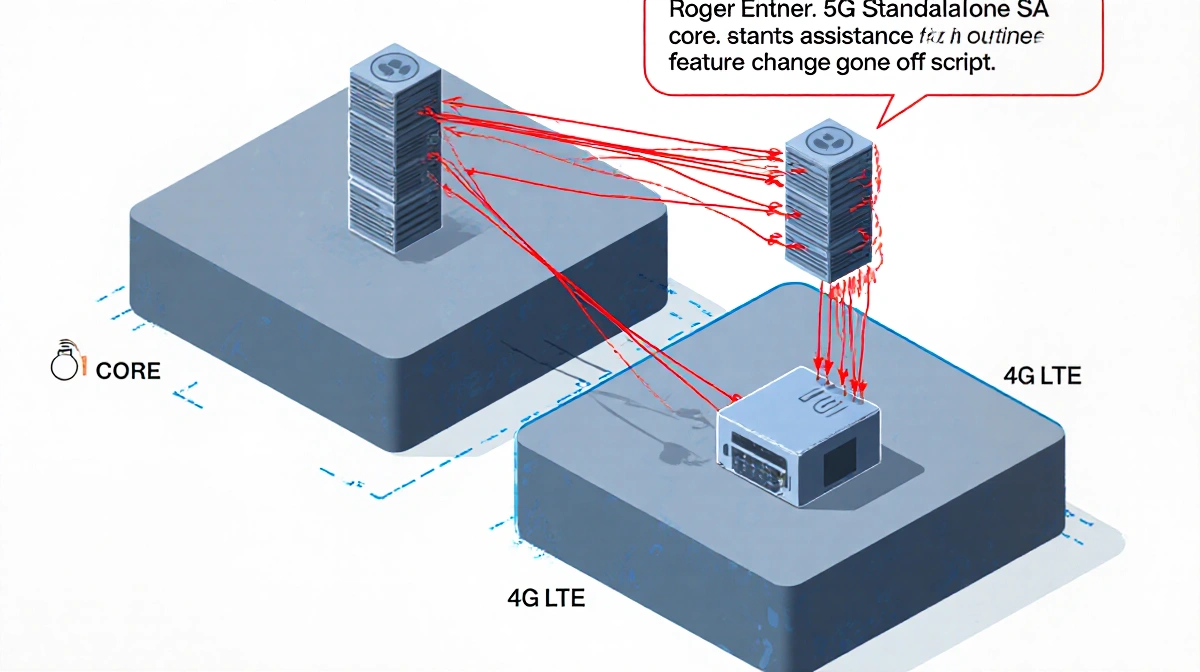
“Data overflows/cascading failures of other VNFs” followed the initial glitch, McKnight wrote in an e-mail. He likens the hiccup to “an engine stalling out,” explaining why some phones reconnected briefly before failing again.
McKnight argues carriers now need cloud-trained engineers, not legacy telco staff, and should fund deeper technical education for existing teams.
Staff Cuts Under Microscope
Reddit threads populated by self-described Verizon veterans point to the company’s recent layoffs of about 13,000 employees, many of them senior engineers. Posts claim the brain drain weakened safeguards that once caught bad updates before they hit live networks.
Neither Verizon nor the analysts confirmed staffing levels as a direct cause, but the discussion underscores unease about carrier workforce shrinkage.
What Comes Next
Verizon has not announced an external review or timeline for a public report. Consumer advocates say transparency will determine whether users trust upcoming 5G home-internet and fixed-wireless expansions.
Key takeaways
- A software change inside Verizon’s 5G-only core is the leading theory among network specialists
- 5G SA deployments remain limited, sparing older 4G devices from the blackout
- A $20 credit is automatic for many, but customers must watch for messages to confirm
- Without a detailed post-mortem, similar stalling outages could recur